Basic Probability Distributions Summary
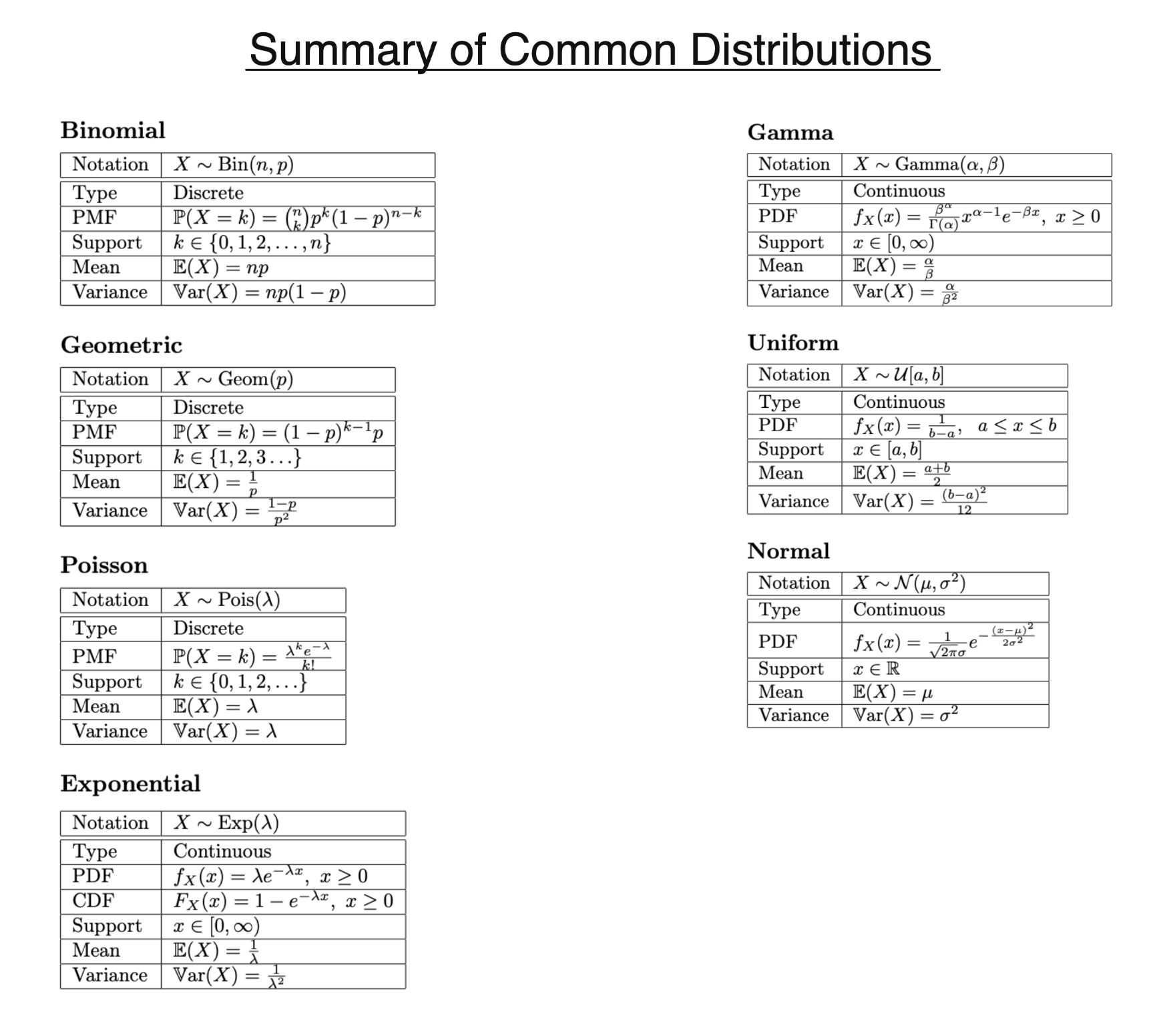
This page provides a quick reference guide to the main probability distributions introduced in this section.
The summary above includes the:
-
binomial distribution;
-
geometric distribution;
-
Poisson distribution;
-
exponential distribution;
-
gamma distribution;
-
uniform distribution;
-
normal distribution.
For each distribution, the table gives its standard notation, whether it is discrete or continuous, its support, and its mean and variance. It also gives the pmf for discrete distributions and the pdf for continuous distributions.
This makes the summary useful once you have identified which distribution applies to a problem: you can then quickly look up its main formulae and properties.
It can also be useful for comparing the distributions side by side. For example, the binomial, geometric and Poisson distributions are discrete, while the exponential, gamma, uniform and normal distributions are continuous.
How to Use the Summary
The formulas in the table are most useful when you already recognise the distribution you are dealing with.
For example, if you know that a problem involves counting successes in a fixed number of independent trials, you may recognise a binomial distribution. You can then use the summary to find its notation, pmf, support, mean and variance.
If you are not yet sure which distribution applies, it is usually better to first think about the situation being modelled and identify the appropriate distribution (see the previous page for more on this).
Background:
Understanding Econometrics is completely free to use, and always will be.
If you found the site useful and would like to help me keep adding new material, please consider buying me a coffee! Buy me a coffee ☕