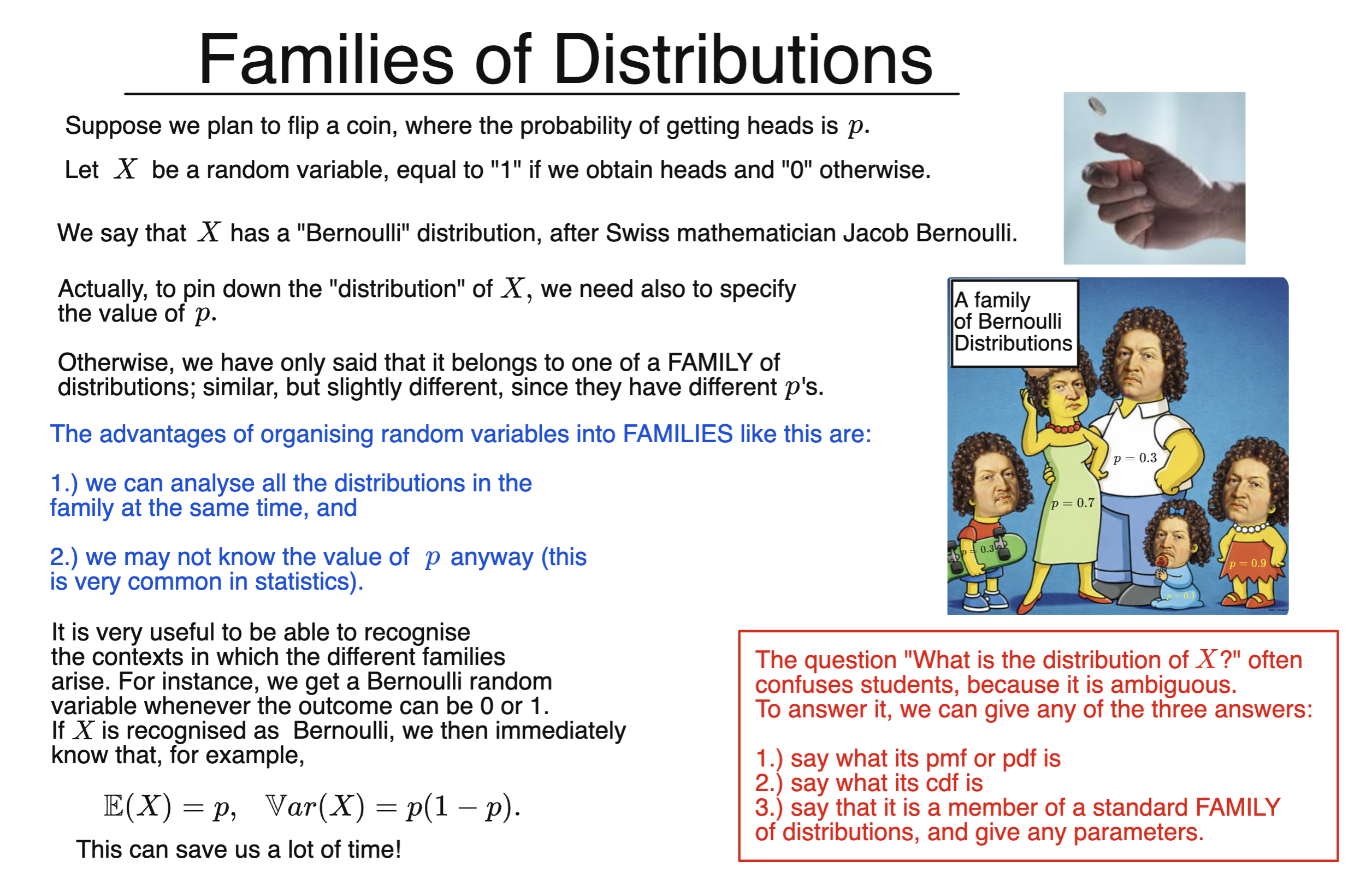
What are Families of Distributions?
A family of distributions is a collection of related probability distributions. Members of such a family are distinguished from each other by one or more numbers called parameters.
For example, suppose $X$ records the result of a coin flip:
$$X=1$$
for heads, and
$$X=0$$
for tails.
If the probability of heads is $p$, then $X$ has a Bernoulli distribution with parameter $p$. We write
$$X\sim\operatorname{Bernoulli}(p).$$
Different values of $p$ give different distributions. For example, a coin with $p=0.5$ behaves differently from one with $p=0.9$. However, both distributions have the same basic form. They belong to the same family of Bernoulli distributions.
The Bernoulli distribution is not limited to literal coin flips. It can be used whenever a random variable has two possible outcomes, $0$ and $1$.
Why are Families Useful?
Grouping distributions into families lets us study many related random variables at the same time.
Once we recognise the family, we immediately know a lot about the distribution without having to start again from scratch.
For example, for any Bernoulli random variable, it can easily be proved that
$$\mathbb{E}(X)=p$$
and
$$\operatorname{Var}(X)=p(1-p).$$
We only need to know the value of the parameter $p$ to apply these results to a particular member of the family.
In statistics, grouping distributions into families is also often useful when the family of a distribution may be known even when the value of its parameter is not.
What Does “the Distribution of $X$” Mean?
If you are asked what “the distribution of $X$” is, the question can be answered in several equivalent ways.
We might:
-
give its pmf or pdf;
-
give its cdf;
-
identify a standard family of distributions and give its parameters.
For example,
$$X\sim\operatorname{Bernoulli}(0.3)$$
tells us both the family and the particular member of that family.
Background:
Understanding Econometrics is completely free to use, and always will be.
If you found the site useful and would like to help me keep adding new material, please consider buying me a coffee! Buy me a coffee ☕