What is a Probability Mass Function?
A probability mass function, or pmf, tells us how likely a discrete random variable is to take each of its possible values.
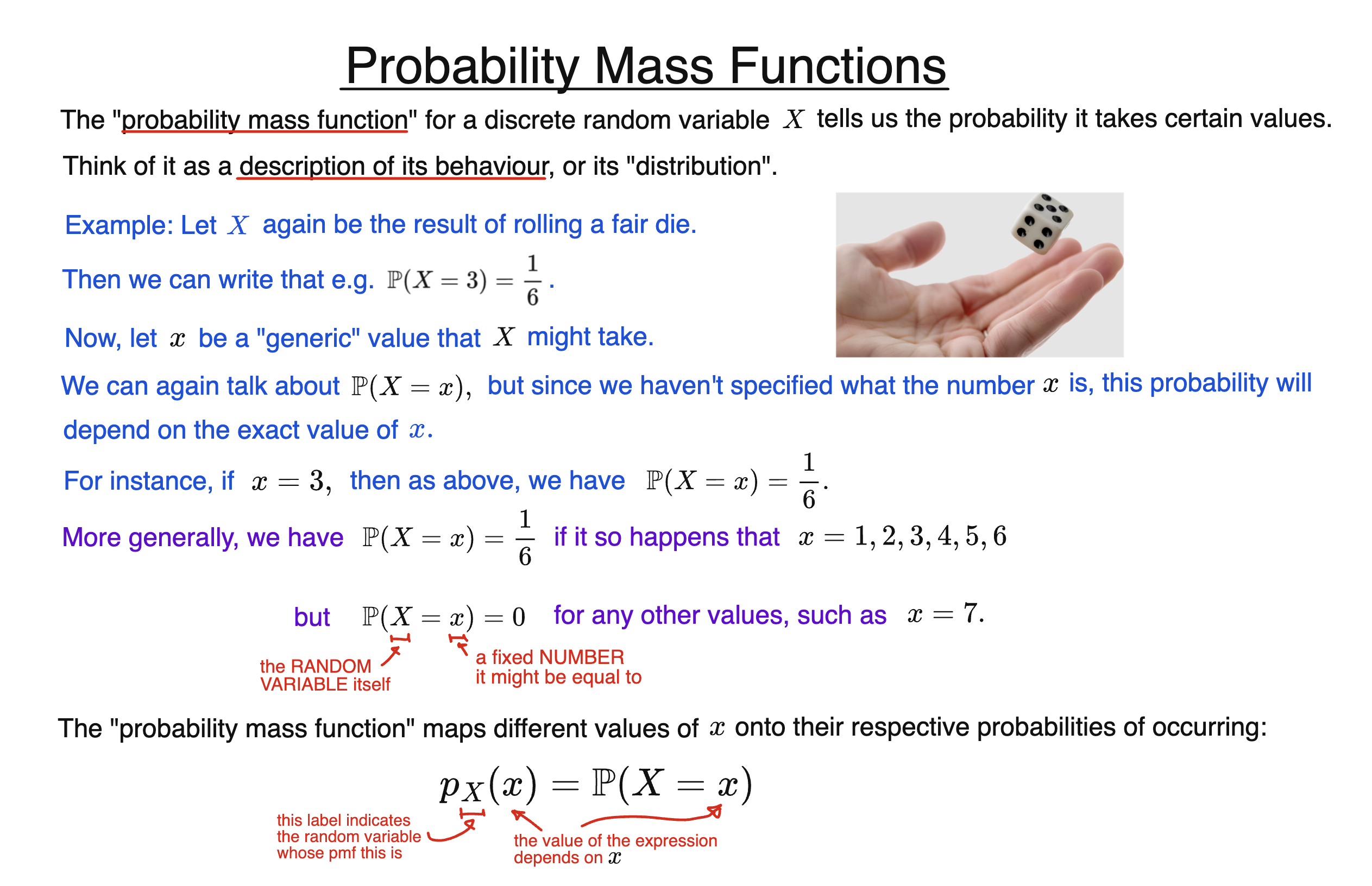
For example, suppose $X$ is the number shown when we roll a fair die. The pmf tells us the probability that $X$ is equal to 1, the probability that it is equal to 2, and so on. For instance,
$$\mathbb{P}(X=3)=\frac{1}{6}.$$
To write this more generally, let $x$ stand for an ordinary numerical value. We define the probability mass function of $X$ by
$$p_X(x)=\mathbb{P}(X=x).$$
Here, the capital $X$ represents the random variable, while the lower-case $x$ represents a particular value we are considering.
For a fair die,
$$p_X(x)=\frac{1}{6}\text{ for }x=1,2,3,4,5,6,\qquad p_X(x)=0\text{ otherwise.}$$
So, for example, $p_X(3)=1/6$, while $p_X(7)=0$.
You can think of the pmf as describing the random variable’s personality, or typical behaviour. It tells us which values are more likely, which are less likely, and which have probability zero. Later, we will use these probabilities to uncover further features of random variables, such as their expectation.
The possible values do not need to be equally likely. Suppose $Y$ is the number of heads we get when we flip two fair coins. Then $Y$ can equal 0, 1 or 2, but
$$p_Y(0)=\frac{1}{4}, \qquad p_Y(1)=\frac{1}{2}, \qquad p_Y(2)=\frac{1}{4}.$$
So $Y=1$ is twice as likely as either $Y=0$ or $Y=2$. The pmf records this directly.
Any probability mass function must satisfy two basic conditions. First, probabilities cannot be negative:
$$p_X(x)\geq 0.$$
Second, the probabilities of all the possible values must add up to 1:
$$\sum_x p_X(x)=1.$$
This simply reflects the fact that the random variable has to take one of its possible values.
Background:
Understanding Econometrics is completely free to use, and always will be.
If you found the site useful and would like to help me keep adding new material, please consider buying me a coffee! Buy me a coffee ☕