What makes a random variable discrete?
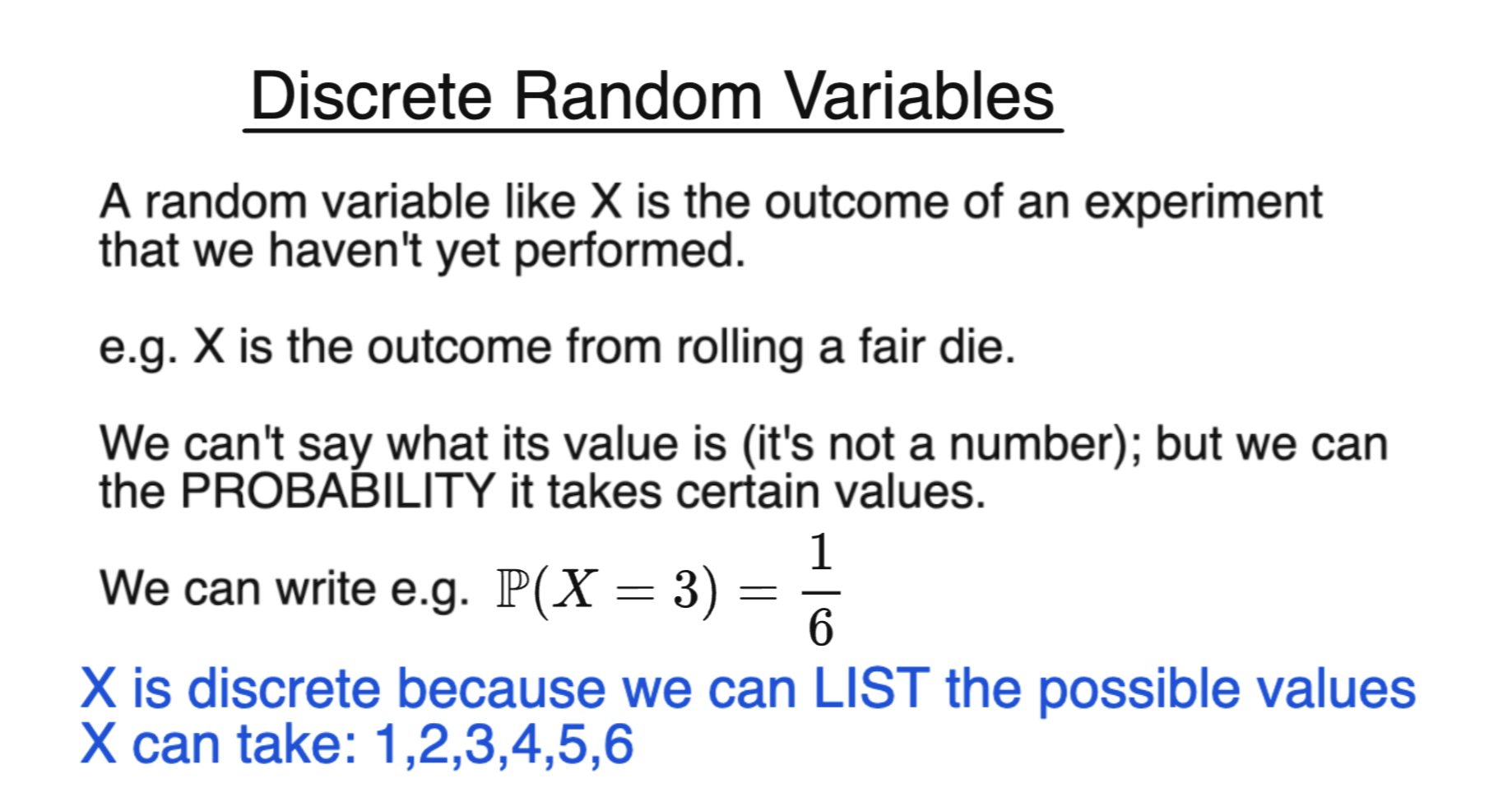
A random variable is discrete if we can arrange all the values it might take into a list. The list may be finite, or it may continue forever.
For example, if $X$ is the number shown when we roll a fair die, then its possible values are
$$1,2,3,4,5,6.$$
Since we can list every possibility, $X$ is a discrete random variable.
A discrete random variable does not need to have only finitely many possible values. Suppose instead that $Y$ is the number of customers who will enter a particular café tomorrow morning. In principle, $Y$ might take any of the values
$$0,1,2,3, \dots $$
The list carries on forever, but we can still arrange all the possibilities in order. So $Y$ is also discrete. A random variable can therefore have infinitely many possible values and still be discrete, as long as those values can be listed.
The values do not need to be consecutive, or equally likely. What matters is simply that all the possibilities can be arranged into a finite or infinite list.
For a discrete random variable, the values that have positive probability are called its support. For the fair die, the support is ${1,2,3,4,5,6}$.
Discrete random variables are especially convenient because we can talk directly about the probability of each individual value, such as $\mathbb{P}(X=3)$. We will develop this idea on the next page.
More formally, the idea of being able to “list” the possible values is captured by the mathematical notion of a countable set. The extension page linked below makes this idea more precise.
Extensions:
Understanding Econometrics is completely free to use, and always will be.
If you found the site useful and would like to help me keep adding new material, please consider buying me a coffee! Buy me a coffee ☕