How Do We Apply the Law of Iterated Expectation?
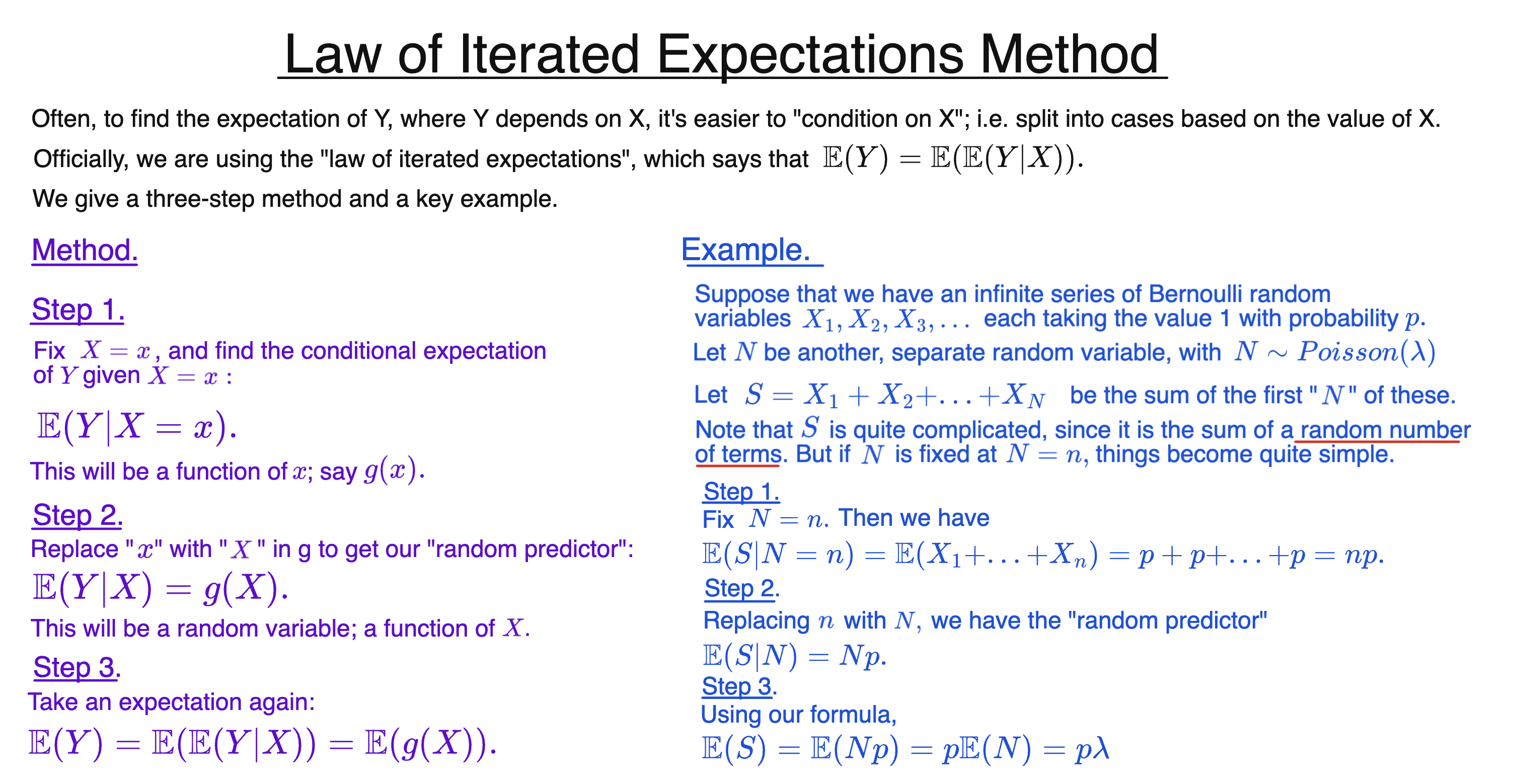
The law of iterated expectation is often useful when we want to find the expected value of a random variable $Y$, and $Y$ depends on another random variable $X$.
The problem often becomes much easier if we first treat $X$ as taking some fixed value $x$.
We can apply this idea systematically in three steps.
Step 1: Fix $X=x$
Treat $X$ as taking some fixed numerical value $x$, and find
$$\mathbb{E}(Y\mid X=x).$$
This will usually be a function of $x$; say
$$\mathbb{E}(Y\mid X=x)=g(x).$$
Step 2: Replace $x$ with $X$
Replace the fixed value $x$ with its random counterpart $X$:
$$\mathbb{E}(Y\mid X)=g(X).$$
This is now a random variable: a function of $X$.
Step 3: Take an Expectation Again
Finally, use the law of iterated expectation:
$$\mathbb{E}(Y)=\mathbb{E}(\mathbb{E}(Y\mid X))=\mathbb{E}(g(X)).$$
In short: condition first, then take an expectation again.
Example: A Normal Distribution with a Random Mean
Suppose we first draw a number $X$ uniformly from the interval $[10,20]$:
$$X\sim\mathcal{U}[10,20].$$
Then, given $X=x$, we draw $Y$ from a normal distribution with mean $x$ and variance $1$:
$$Y\big|_{X=x}\sim\mathcal{N}(x,1).$$
The unconditional distribution of $Y$ is quite complicated: it is like a normal distribution, but with a “random parameter” (later we will call distributions like this compound distributions).
Fortunately, with our method, finding its expectation is much easier.
Step 1: Fix $X=x$
Given $X=x$,
$$Y\big|_{X=x}\sim\mathcal{N}(x,1).$$
The mean of this normal distribution is $x$, so
$$\mathbb{E}(Y\mid X=x)=x.$$
Step 2: Replace $x$ with $X$
Replacing the fixed value $x$ with its random counterpart $X$ gives
$$\mathbb{E}(Y\mid X)=X.$$
Step 3: Take an Expectation Again
Using the law of iterated expectation,
$$\mathbb{E}(Y)=\mathbb{E}(\mathbb{E}(Y\mid X))=\mathbb{E}(X).$$
For a uniform random variable on $[10,20]$,
$$\mathbb{E}(X)=\frac{10+20}{2}=15.$$
Therefore,
$$\mathbb{E}(Y)=15.$$
We have found the expected value of $Y$ without first having to work out its unconditional distribution.
Background:
Understanding Econometrics is completely free to use, and always will be.
If you found the site useful and would like to help me keep adding new material, please consider buying me a coffee! Buy me a coffee ☕