What Is an Expected Value?
The expected value of a random variable tells us, roughly speaking, where its values tend to lie on average. It is one of the most important ways of describing the “personality” of a random variable.
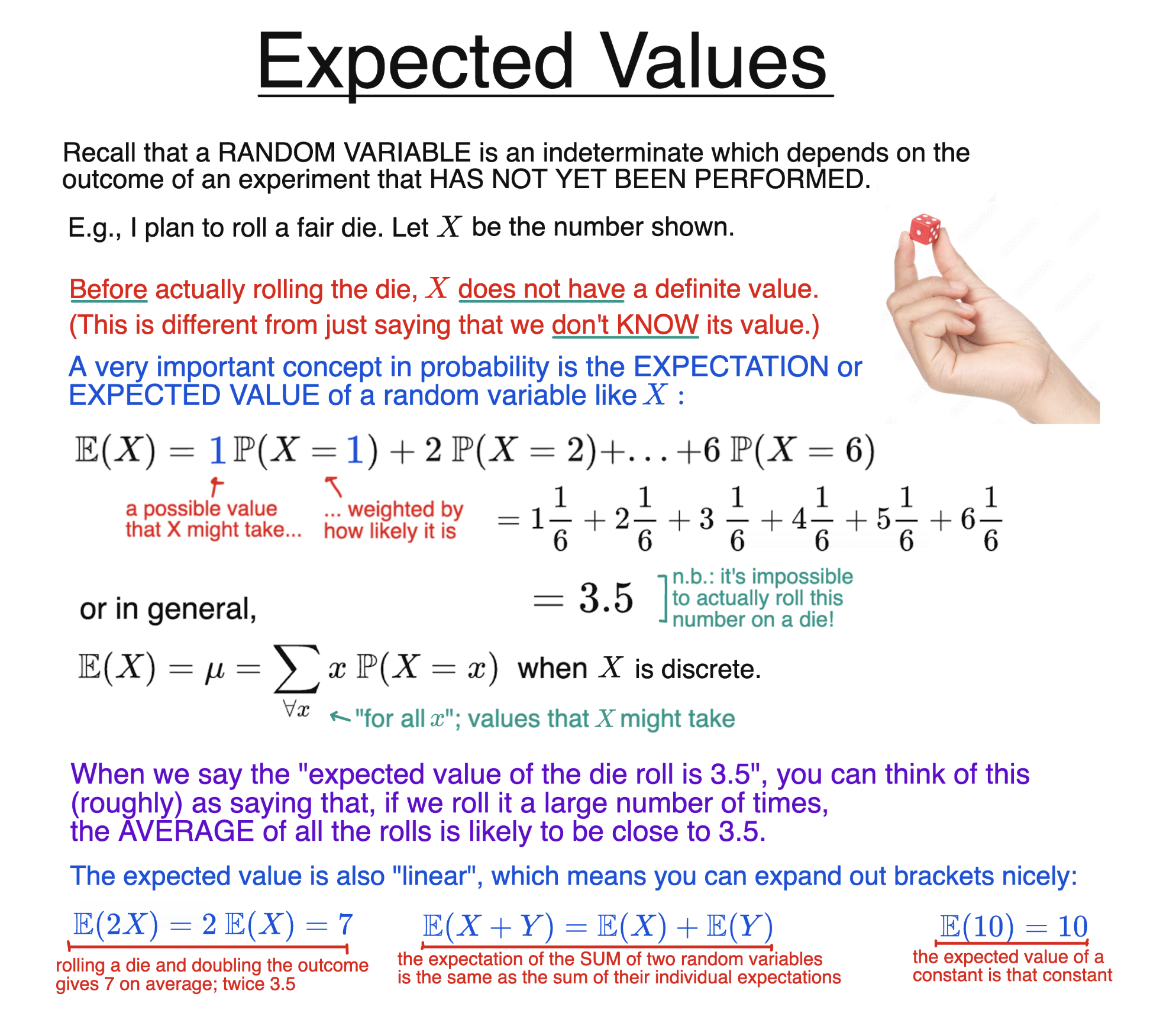
Suppose we plan to roll a fair die, and let $X$ be the number that will appear. The possible values are
$$1,2,3,4,5,6.$$
Notice that $3.5$ lies exactly in the middle of these possible values.
Now imagine rolling the die many times and finding the average of the results. We would expect this average to be close to $3.5$. This gives us some intuition for the expected value of $X$.
Notice something slightly strange here: it is impossible to actually roll $3.5$ on a die! The expected value does not have to be one of the values that the random variable can take.
To give the precise definition of the expected value of $X$, we use a weighted average. We take each possible value of $X$, multiply it by the probability that $X$ takes that value, and then add the resulting terms together. That is:
$$\mathbb{E}(X)=1\times\frac{1}{6}+2\times\frac{1}{6}+3\times\frac{1}{6}+4\times\frac{1}{6}+5\times\frac{1}{6}+6\times\frac{1}{6}=3.5.$$
Now let $X$ stand for any discrete random variable. If it exists, its expected value is given by the following formula:
$$\mathbb{E}(X)=\sum_x x \ \mathbb{P}(X=x).$$
However, in some rare cases the sum does not converge to a finite value, and the expected value may not be defined. These cases are not of much interest in econometrics, however.
Note that the sum is taken over all the possible values of $X$, and each value is given more or less weight depending on how likely it is to occur.
The expected value is also called the expectation or mean of a random variable, and is often written using $\mu$ (“mu”), the Greek counterpart of the letter “m” (for mean).
Another important feature of expectation is that it is linear. Intuitively, this means that we can multiply out brackets nicely. More formally, this is expressed by the following two rules.
For constants $a$ and $b$,
$$\mathbb{E}(aX+b)=a\mathbb{E}(X)+b.$$
So, for example, doubling every possible value of $X$ also doubles its expected value.
Likewise, for two random variables $X$ and $Y$,
$$\mathbb{E}(X+Y)=\mathbb{E}(X)+\mathbb{E}(Y).$$
These properties make expected values particularly convenient to work with.
Note, however, that generally we cannot bring more complicated operations outside the expected value. For example,
$$\mathbb{E}(X^2)\ne \left(\mathbb{E}(X)\right)^2$$
in general.
For continuous random variables, the same basic idea applies, but we proceed a little differently.
Background:
Understanding Econometrics is completely free to use, and always will be.
If you found the site useful and would like to help me keep adding new material, please consider buying me a coffee! Buy me a coffee ☕