How Do We Find Expected Values?
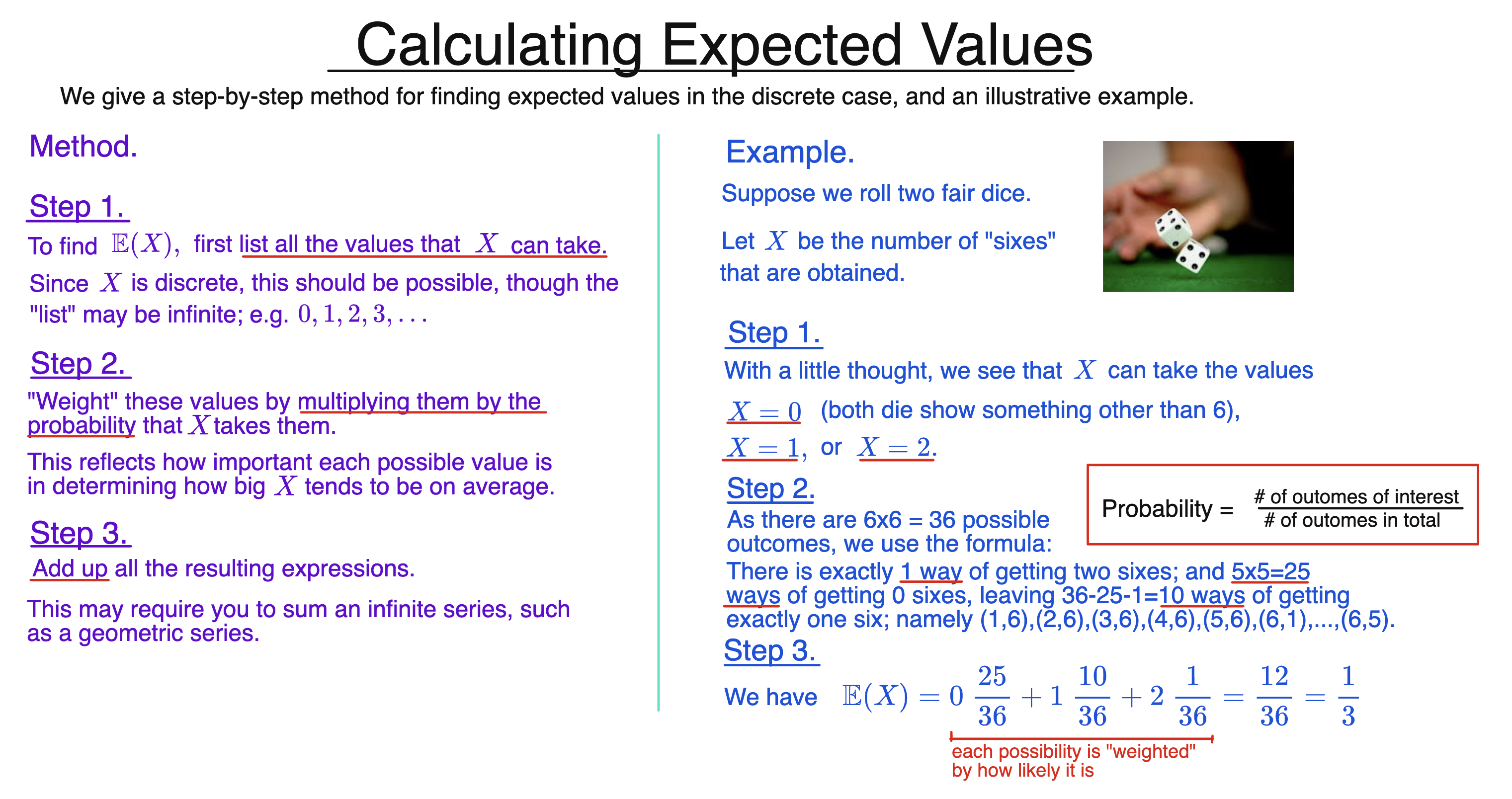
To calculate the expected value of a discrete random variable, we list its possible values, multiply each value by its probability, and then add the resulting terms together.
Recall the formula
$$\mathbb{E}(X)=\sum_x x \ \mathbb{P}(X=x).$$
The above description turns this into a simple three-step method:
-
List the possible values. Write down all the values that $X$ can take. Since $X$ is discrete, these can be arranged into a list, although the list may sometimes continue forever.
-
Weight each value by its probability. For every possible value $x$, find $\mathbb{P}(X=x)$ and calculate the product $x\ \mathbb{P}(X=x)$. Values $x$ that are more likely to occur receive more weight.
-
Add the terms together. The resulting sum is $\mathbb{E}(X)$. If there are infinitely many possible values, this may involve summing an infinite series.
For example, suppose we flip three fair coins and let $X$ be the number of heads. The possible values of $X$ are
$$0,1,2,3.$$
If we list out all the possible outcomes for the three coins:
$$HHH,HHT,HTH,HTT,THH,THT,TTH,TTT$$
We see that there is precisely one way to get $0$ heads, three ways to get $1$ head, three ways to get $2$ heads, and one way to get $3$ heads. Since the eight possible sequences are equally likely,
$$\mathbb{P}(X=0)=\frac{1}{8},\qquad \mathbb{P}(X=1)=\frac{3}{8},\qquad \mathbb{P}(X=2)=\frac{3}{8},\qquad \mathbb{P}(X=3)=\frac{1}{8}.$$
We now weight each possible value by its probability and add:
$$\mathbb{E}(X)=0\times\frac{1}{8}+1\times\frac{3}{8}+2\times\frac{3}{8}+3\times\frac{1}{8}=\frac{12}{8}=1.5.$$
So the expected number of heads is $1.5$. Of course, we cannot actually obtain one and a half heads in a single set of three flips. As with the die example on the previous page, the expected value describes where the outcomes lie on average rather than predicting one particular outcome.
The arithmetic can become more complicated in other examples, but the method is always the same: list, weight, and add.
Background:
Understanding Econometrics is completely free to use, and always will be.
If you found the site useful and would like to help me keep adding new material, please consider buying me a coffee! Buy me a coffee ☕