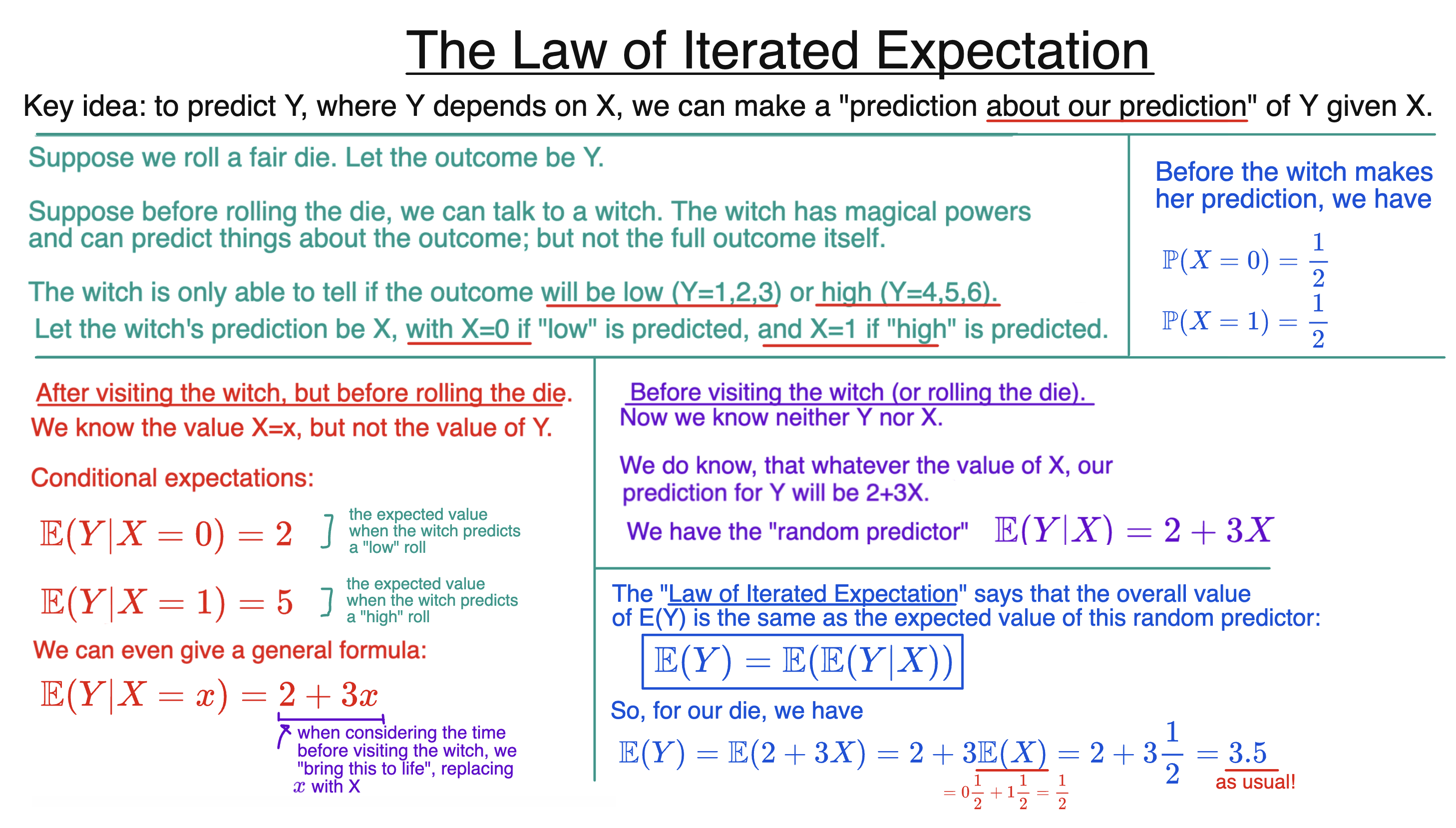
What Is the Law of Iterated Expectation?
The law of iterated expectation says that we can find the expected value of a random variable $Y$ by first finding its conditional expectation given another random variable $X$, and then taking an expectation again:
$$\mathbb{E}(Y)=\mathbb{E}(\mathbb{E}(Y\mid X)).$$
It is also known as the tower property.
The inner expectation,
$$\mathbb{E}(Y\mid X),$$
is itself a random variable: it represents our prediction for $Y$ based on the information contained in $X$, but while $X$ is still random. In fact, it is a function of $X$.
The outer expectation then averages this “random predictor” $\mathbb{E}(Y\mid X)$ over the possible values of $X$.
So the law says that the expectation of this conditional “random predictor” is the same as the overall expected value of $Y$.
Let’s use our balls-and-coins example to see this in action.
Example: Balls and Coin Flips
Suppose we have three balls labelled $1$, $2$ and $3$ in a bag, and a fair coin.
We pick one ball at random and let $X$ be the number written on it.
We then flip the coin $X$ times, and let $Y$ be the total number of heads obtained.
Since each fair coin toss contributes $0.5$ heads on average, we have:
$$\mathbb{E}(Y\mid X=1)=0.5,$$
$$\mathbb{E}(Y\mid X=2)=1,$$
and
$$\mathbb{E}(Y\mid X=3)=1.5.$$
We can summarise these three cases as
$$\mathbb{E}(Y\mid X=x)=0.5x,\qquad x=1,2,3.$$
Once $x$ is fixed, this is just a number.
Before we know which ball will be drawn, however, $X$ is still random. Replacing the fixed value $x$ with the random variable $X$ gives
$$\mathbb{E}(Y\mid X)=0.5X.$$
This is our random predictor for $Y$.
Taking an Expectation Again
The law of iterated expectation tells us to take the expected value of this random predictor:
$$\mathbb{E}(Y)=\mathbb{E}(\mathbb{E}(Y\mid X)).$$
In our example,
$$\mathbb{E}(Y)=\mathbb{E}(0.5X).$$
Since the three balls are equally likely,
$$\mathbb{E}(X)=1\times\frac{1}{3}+2\times\frac{1}{3}+3\times\frac{1}{3}=2.$$
Therefore,
$$\mathbb{E}(Y)=\mathbb{E}(0.5X)=0.5\mathbb{E}(X)=0.5\times2=1.$$
So the expected number of heads is $1$.
This is the law of iterated expectations in action: taking the expectation of $\mathbb{E}(Y\mid X)$ gives us $\mathbb{E}(Y)$.
Background:
Understanding Econometrics is completely free to use, and always will be.
If you found the site useful and would like to help me keep adding new material, please consider buying me a coffee! Buy me a coffee ☕