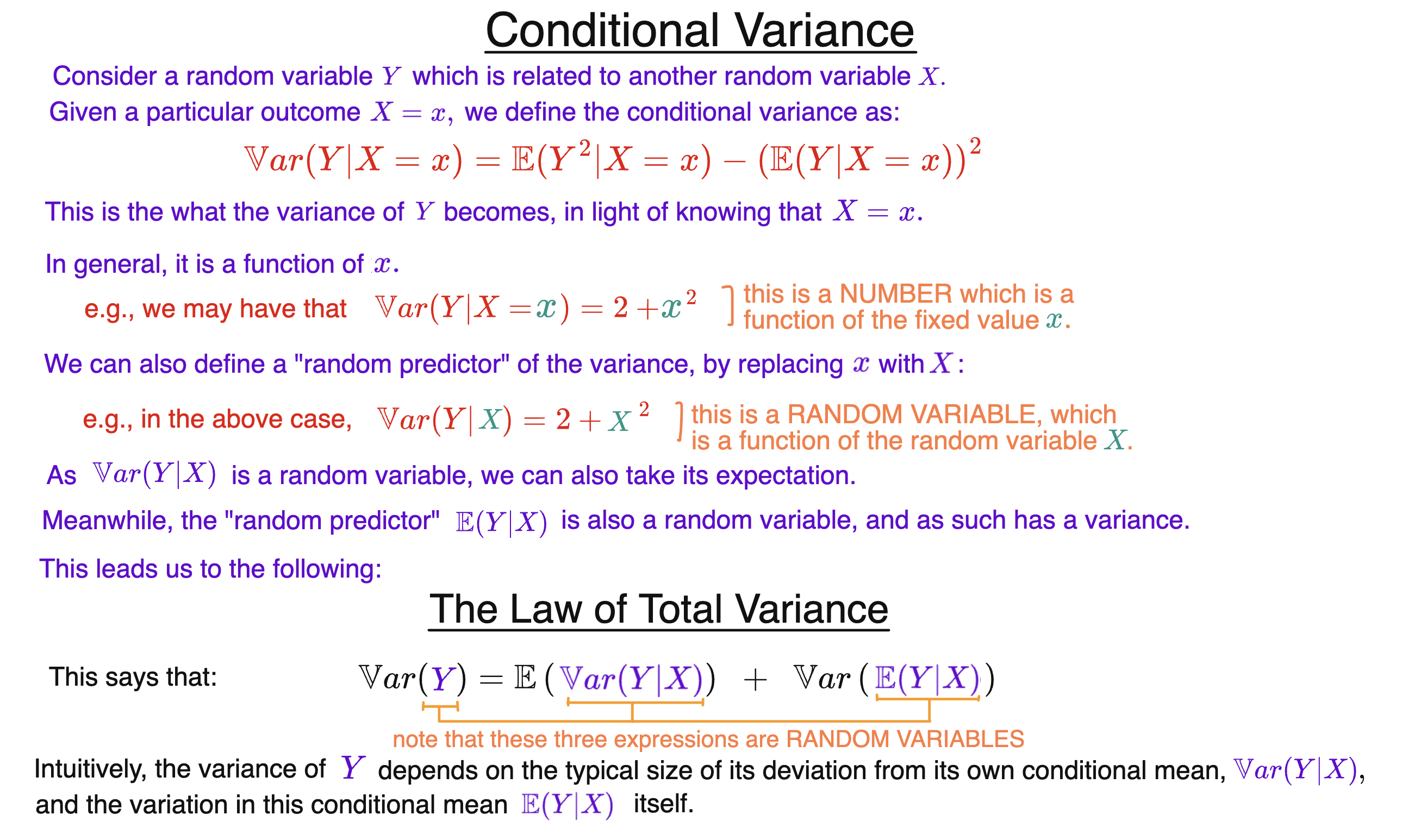
The law of total variance decomposes the variance of a random variable $Y$ into two parts:
$$\operatorname{Var}(Y)=\mathbb{E}(\operatorname{Var}(Y\mid X))+\operatorname{Var}(\mathbb{E}(Y\mid X))$$
Intuitively,
total variance = average within-group variance + between-group variance.
The first term measures how much $Y$ varies within groups defined by $X$, on average. The second measures how much the conditional mean of $Y$ varies between those groups.
To fully understand the formula, we first need to master the idea of conditional variance.
What Is Conditional Variance?
The conditional variance of $Y$ given $X=x$ measures how much $Y$ varies once we know that $X=x$.
Recall that
$$\operatorname{Var}(Y)=\mathbb{E}(Y^2)-(\mathbb{E}(Y))^2.$$
Conditional variance uses the same formula, but with conditional expectations:
$$\operatorname{Var}(Y\mid X=x)=\mathbb{E}(Y^2\mid X=x)-(\mathbb{E}(Y\mid X=x))^2.$$
So $\operatorname{Var}(Y\mid X=x)$ is a number once $x$ is fixed.
For example, suppose $Y$ is a fair die roll. Let
-
$X=0$ if the roll is low, so $Y\in{1,2,3}$;
-
$X=1$ if the roll is high, so $Y\in{4,5,6}$.
Given $X=0$,
$$\mathbb{E}(Y\mid X=0)=1\times\frac{1}{3}+2\times\frac{1}{3}+3\times\frac{1}{3}=2.$$
Also,
$$\mathbb{E}(Y^2\mid X=0)=1^2\times\frac{1}{3}+2^2\times\frac{1}{3}+3^2\times\frac{1}{3}=\frac{14}{3}.$$
Hence,
$$\operatorname{Var}(Y\mid X=0)=\frac{14}{3}-2^2=\frac{2}{3}.$$
The same variance applies when $X=1$, since the values $4,5,6$ have exactly the same spread as $1,2,3$.
Conditional variances are very important in econometrics, particularly the conditional variance of an error term given another variable:
$$\operatorname{Var}(U\mid X=x).$$
Conditional Variance as a Random Variable
In general, $\operatorname{Var}(Y\mid X=x)$ may depend on the value of $x$.
For example, we might have
$$\operatorname{Var}(Y\mid X=x)=2+x^2.$$
Once $x$ is fixed, this is a number.
Replacing the fixed value $x$ with the random variable $X$ gives
$$\operatorname{Var}(Y\mid X)=2+X^2.$$
This is itself a random variable: its value depends on the random value of $X$.
We can therefore take its expectation:
$$\mathbb{E}(\operatorname{Var}(Y\mid X)).$$
This measures the average conditional variance of $Y$.
Conditional Expectation as a Random Variable
Recall that the conditional expectation $\mathbb{E}(Y\mid X)$ is also a random variable.
If, for a fixed value $x$,
$$\mathbb{E}(Y\mid X=x)=g(x),$$
then replacing $x$ with its random counterpart $X$ gives
$$\mathbb{E}(Y\mid X)=g(X).$$
Since $X$ is random, $\mathbb{E}(Y\mid X)$ is also random: its value changes according to the value taken by $X$.
Provided its variance exists, we can therefore calculate
$$\operatorname{Var}(\mathbb{E}(Y\mid X)).$$
This measures how much the conditional mean of $Y$ varies as $X$ varies.
What Is the Law of Total Variance?
The law of total variance says
$$\operatorname{Var}(Y)=\mathbb{E}(\operatorname{Var}(Y\mid X))+\operatorname{Var}(\mathbb{E}(Y\mid X))$$
provided the relevant second moments exist.
The two terms have different meanings. These are easiest to explain if $X$ represents membership in a certain group (including low vs. high rolls of a die).
In such cases, the first term,
$$\mathbb{E}(\operatorname{Var}(Y\mid X)),$$
is the average amount of variation in $Y$ within the groups defined by $X$.
The second term,
$$\operatorname{Var}(\mathbb{E}(Y\mid X)),$$
measures how much the conditional mean of $Y$ varies as $X$ changes, i.e. between the groups defined by $X$.
So the total variance formula separates the variation in $Y$ into:
-
variation within groups;
-
variation between the conditional means of those groups.
Example: A Fair Die
In the fair-die example above,
$$\operatorname{Var}(Y\mid X)=\frac{2}{3}.$$
Since this is constant,
$$\mathbb{E}(\operatorname{Var}(Y\mid X))=\frac{2}{3}.$$
We also have
$$\mathbb{E}(Y\mid X)=2+3X.$$
Since $X$ takes the values $0$ and $1$ with equal probability,
$$\operatorname{Var}(X)=\frac{1}{4}.$$
Therefore,
$$\operatorname{Var}(\mathbb{E}(Y\mid X))=\operatorname{Var}(2+3X)=9\operatorname{Var}(X)=\frac{9}{4}.$$
Applying the law of total variance,
$$\operatorname{Var}(Y)=\frac{2}{3}+\frac{9}{4}=\frac{35}{12}.$$
This is exactly the variance of a fair six-sided die.
The overall variation therefore consists of two parts: the variation among outcomes within the low or high group, and the variation between the mean of the low group and the mean of the high group.
Within-Group and Between-Group Variation
The same interpretation is useful in real-world settings.
Suppose $Y$ represents an employee’s wages and $X$ represents the industry they work in.
Then
$$\mathbb{E}(\operatorname{Var}(Y\mid X))$$
measures the average variation in wages within industries, while
$$\operatorname{Var}(\mathbb{E}(Y\mid X))$$
measures the variation in average wages between industries.
The law of total variance tells us that both sources contribute to the overall variation in wages:
$$\text{total variance}=\text{average within-group variance}+\text{between-group variance}$$
Background:
Understanding Econometrics is completely free to use, and always will be.
If you found the site useful and would like to help me keep adding new material, please consider buying me a coffee! Buy me a coffee ☕