How Does the Sum of Two Random Variables Behave?
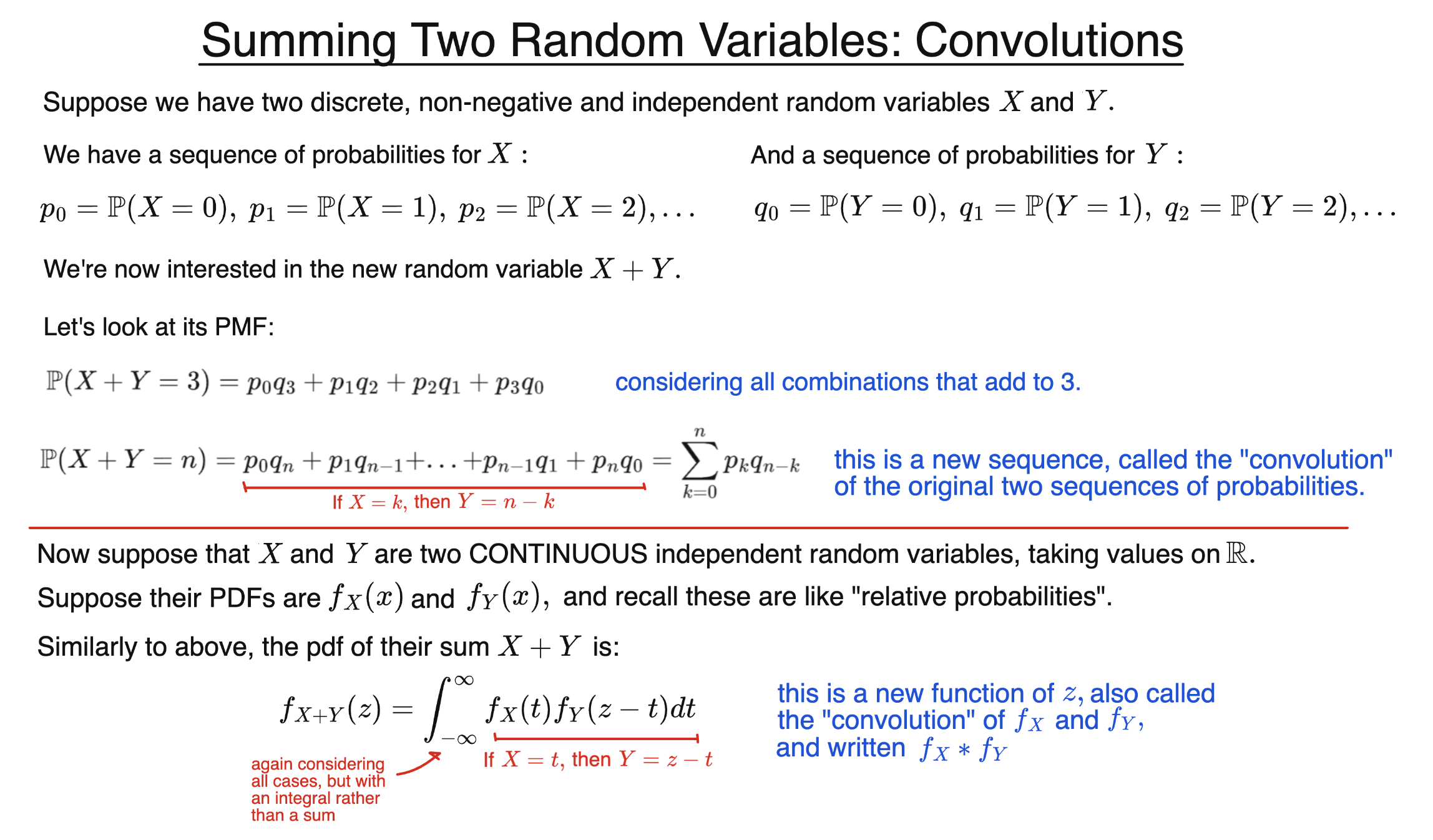
Suppose we have two independent random variables $X$ and $Y$. We form the new random variable $X+Y$, and would like to know its probability distribution.
We can find the answer using a convolution!
We begin with the discrete case, where the idea is easiest to see.
The Discrete Case
Suppose $X$ and $Y$ are independent random variables which take non-negative integer values.
For $X$, we have the sequence of probabilities
$$p_0=\mathbb{P}(X=0), \quad p_1=\mathbb{P}(X=1), \quad p_2=\mathbb{P}(X=2), \dots$$
For $Y$, we have
$$q_0=\mathbb{P}(Y=0), \quad q_1=\mathbb{P}(Y=1), \quad q_2=\mathbb{P}(Y=2), \dots$$
More generally,
$$p_k=\mathbb{P}(X=k)$$
and
$$q_k=\mathbb{P}(Y=k).$$
Now suppose we want to find
$$\mathbb{P}(X+Y=3).$$
There are four possible ways for this to happen:
- $X=0$ and $Y=3$
- $X=1$ and $Y=2$
- $X=2$ and $Y=1$
- $X=3$ and $Y=0$
Since $X$ and $Y$ are independent, we multiply the probabilities within each case. We then add the four possibilities together:
$$\mathbb{P}(X+Y=3)=p_0q_3+p_1q_2+p_2q_1+p_3q_0.$$
More generally, to get $X+Y=n$, the possible combinations are
$$X=0,\ Y=n$$
$$X=1,\ Y=n-1$$
$$X=2,\ Y=n-2$$
$$\dots$$
$$X=n,\ Y=0.$$
So,
$$\mathbb{P}(X+Y=n)=p_0q_n+p_1q_{n-1}+p_2q_{n-2}+\dots+p_nq_0.$$
We can write the same thing more compactly as
$$\mathbb{P}(X+Y=n)=\sum_{k=0}^n p_kq_{n-k}.$$
The probabilities for $X+Y$ form a new sequence. This sequence is called the convolution of the original probability sequences for $X$ and $Y$.
The key idea is simple: we consider every combination of values that adds up to the required total.
The Continuous Case
Now suppose instead that $X$ and $Y$ are independent continuous random variables, with pdfs $f_X$ and $f_Y$.
We again want to find the distribution of their sum $X+Y$.
Suppose
$$X+Y=z.$$
For example, some possible combinations are
$$X=0,\ Y=z$$
$$X=1,\ Y=z-1$$
$$X=2,\ Y=z-2$$
and so on.
More generally, if $X=t$, then
$$Y=z-t.$$
Since $X$ and $Y$ are independent, their joint pdf is the product of their individual pdfs. For a particular value of $t$, this gives
$$f_X(t)f_Y(z-t).$$
In the discrete case, we added over all possible values. In the continuous case, we instead integrate over all possible values of $t$.
This gives the pdf of the sum:
$$f_{X+Y}(z)=\int_{-\infty}^{\infty} f_X(t)f_Y(z-t) \ dt.$$
This new function is called the convolution of $f_X$ and $f_Y$.
It is often written
$$f_{X+Y}=f_X*f_Y.$$
So the discrete and continuous cases follow the same basic pattern:
- in the discrete case, we sum over all combinations which give the required total;
- in the continuous case, we integrate over all combinations which give the required total.
When the Random Variables Are Non-Negative
Suppose $X$ and $Y$ are still independent and continuous, but can only take non-negative values.
For $z>0$, we have
$$X=t$$
and
$$Y=z-t.$$
For both of these values to be non-negative, $t$ must lie between $0$ and $z$.
So in this case,
$$f_{X+Y}(z)=\int_0^z f_X(t)f_Y(z-t) \ dt.$$
This is the same convolution formula, but the limits now only cover values of $t$ which are actually possible.
Background:
Understanding Econometrics is completely free to use, and always will be.
If you found the site useful and would like to help me keep adding new material, please consider buying me a coffee! Buy me a coffee ☕