Addition and Multiplication Rules
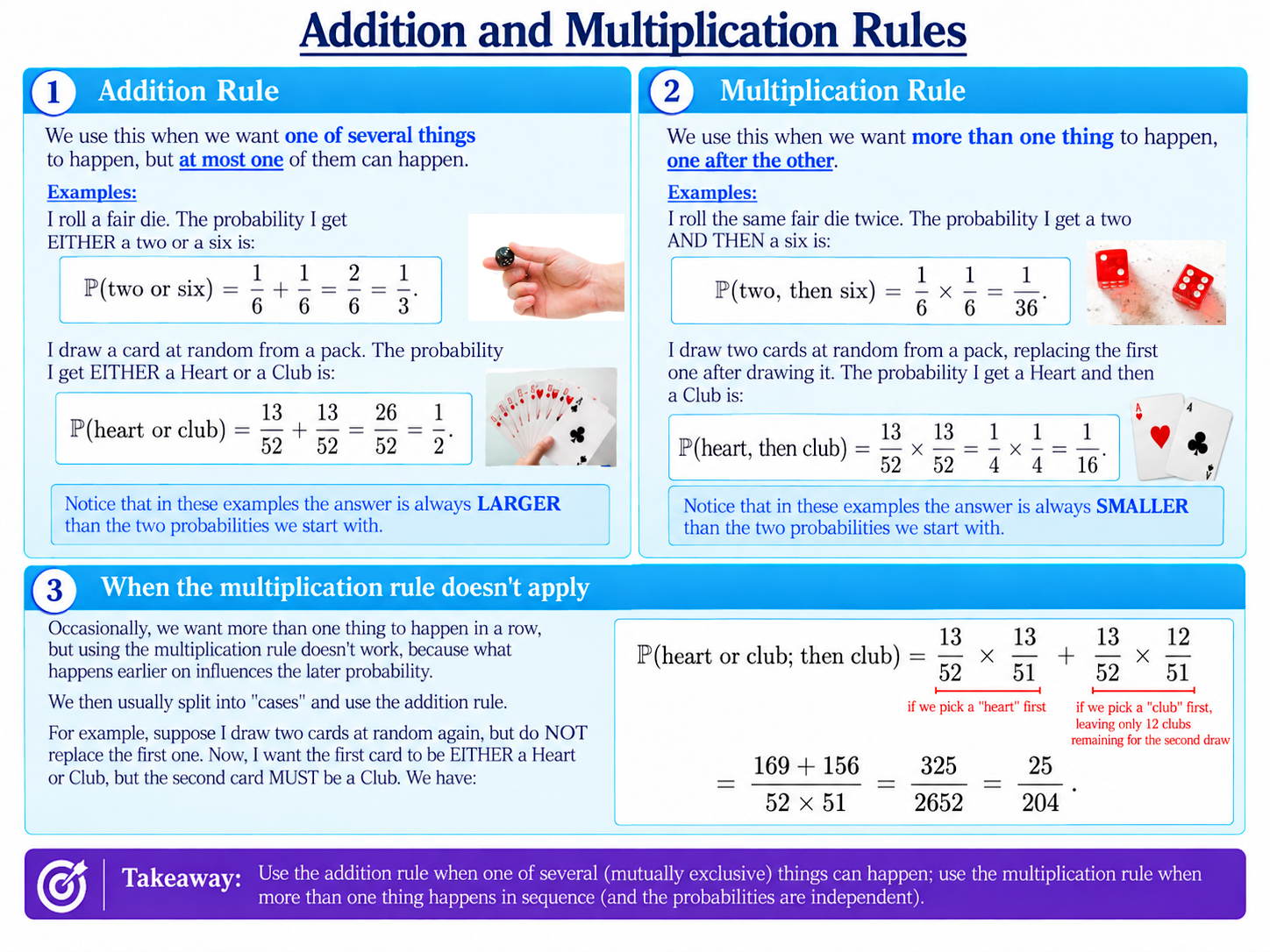
The addition and multiplication rules are two simple ways to calculate probabilities. We add probabilities when we want one of several possible things to happen, and multiply when several things must happen in sequence.
The addition rule
Suppose a bag contains ten numbered balls, from 1 to 10, and we pick one at random.
The probability of picking a 1 is $1/10$, and the probability of picking a 2 is also $1/10$. If we want to pick either a 1 or a 2, we add:
$$\mathbb{P}(\text{1 or 2}) = \frac{1}{10}+\frac{1}{10}=\frac{1}{5}$$
The addition rule works here because only one of these outcomes can occur.
The multiplication rule
Now suppose we toss a fair coin and then roll a fair six-sided die.
The probability of getting Heads is $1/2$. The probability of then rolling a 6 is $1/6$. Since the coin toss does not affect the die roll, we multiply:
$$\mathbb{P}(\text{Heads, then 6}) = \frac{1}{2}\times\frac{1}{6}=\frac{1}{12}$$
The multiplication rule works when we want several things to happen in sequence, and the earlier outcomes do not affect the later probabilities.
Sometimes a probability problem requires us to split the calculation into several possible cases. We can multiply within each case, then add the resulting probabilities together.
Understanding Econometrics is completely free to use, and always will be.
If you found the site useful and would like to help me keep adding new material, please consider buying me a coffee! Buy me a coffee ☕