Conditional Probability
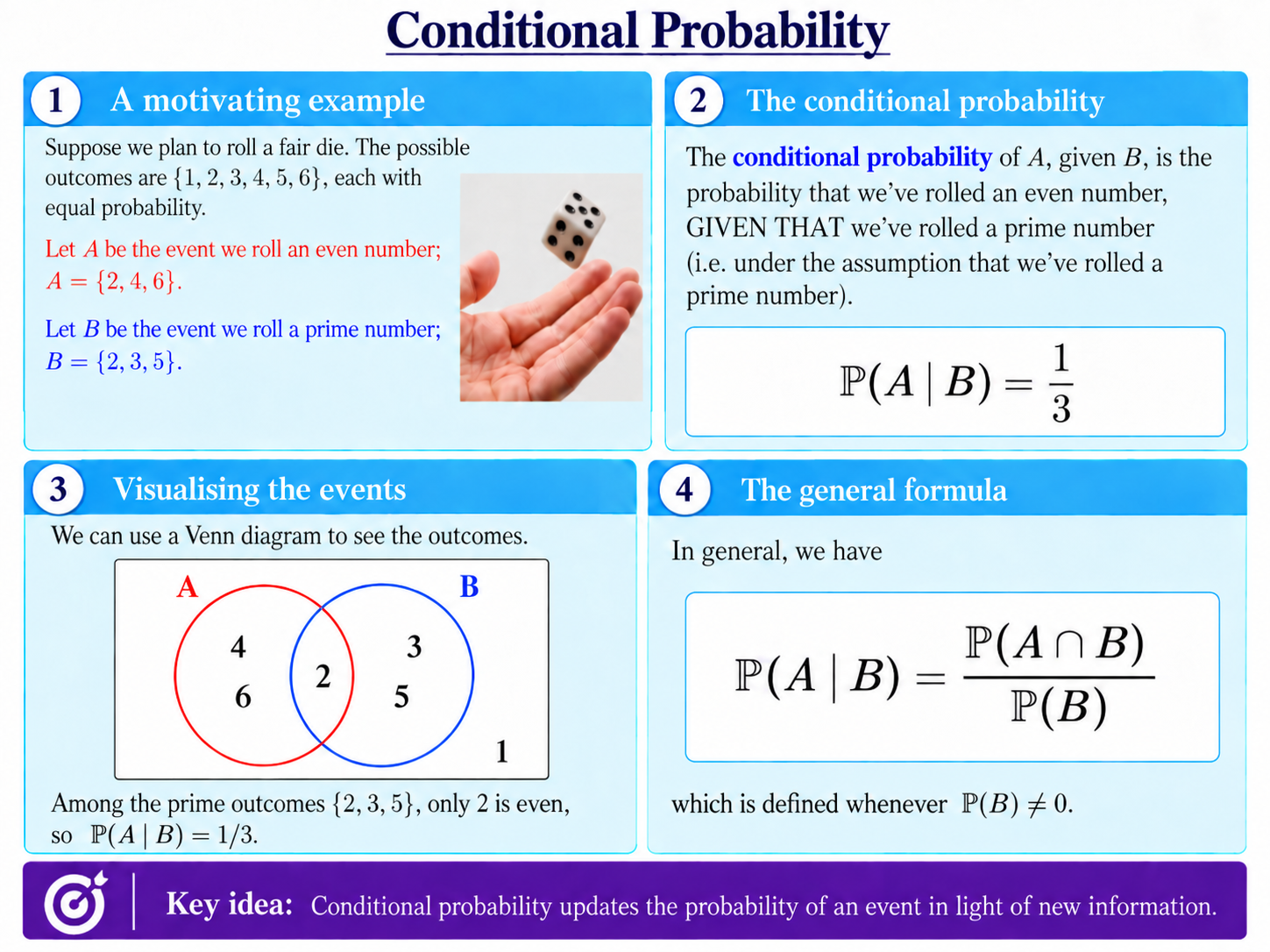
Conditional probability describes how the probability of an event changes when we are given some additional information.
Given two events $A$ and $B$, the conditional probability of $A$ given $B$ is written $\mathbb{P}(A \mid B)$. It tells us the probability of $A$ under the assumption that $B$ has occurred.
The general formula is:
$$\mathbb{P}(A \mid B) = \frac{\mathbb{P}(A \cap B)}{\mathbb{P}(B)}$$
This is defined whenever $\mathbb{P}(B) \ne 0$.
For example, suppose we draw one card from a standard pack and are told that it is a face card: a Jack, Queen, or King. We’d now like to know the probability that the card is a King, taking this into account.
There are 12 face cards altogether, of which 4 are Kings. The conditional probability that the card is a King is:
$$\mathbb{P}(\text{King} \mid \text{Face card}) = \frac{4}{12} = \frac{1}{3}$$
The formula comes from the fact that conditioning changes the set of possibilities we are considering. Once we know that the card is a face card, the other 40 cards are no longer relevant to the calculation.
Understanding Econometrics is completely free to use, and always will be.
If you found the site useful and would like to help me keep adding new material, please consider buying me a coffee! Buy me a coffee ☕