Classical Probabilities
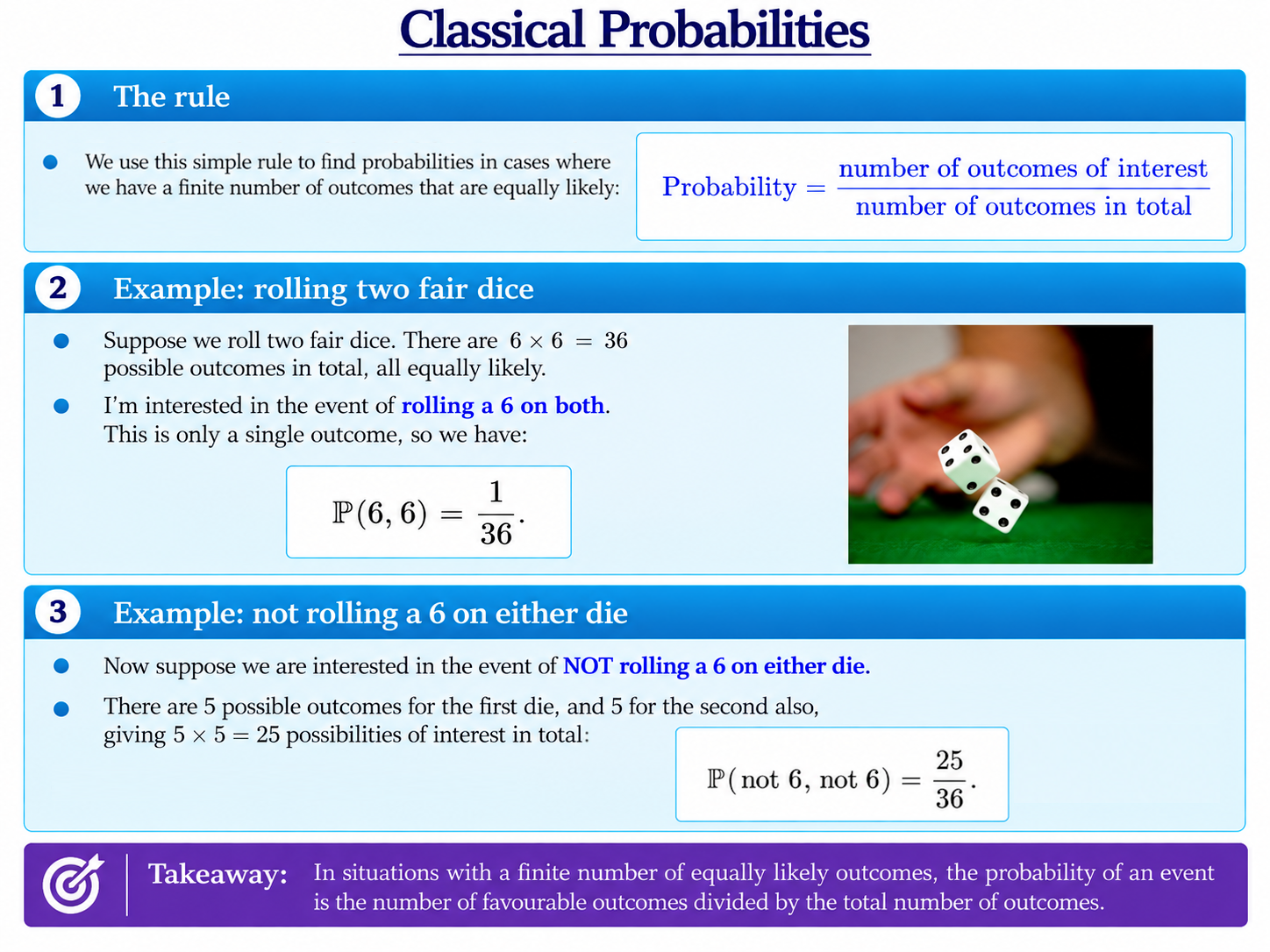
Classical probability applies when there are a finite number of possible outcomes, all of which are equally likely. In this setting, probabilities can be found simply by counting outcomes.
The study of probability originated with games of chance involving dice and cards, where situations like this arise naturally.
To find probabilities in such settings, we divide the number of outcomes we are interested in by the total number of possible outcomes:
$$\text{Probability} = \frac{\text{number of outcomes of interest}}{\text{total number of possible outcomes}}$$
For example, suppose we draw one card at random from a standard pack of 52 cards.
There are four kings, so the probability of drawing a king is:
$$\mathbb{P}(\text{King}) = \frac{4}{52} = \frac{1}{13}$$
The important condition is that the possible outcomes must be equally likely. If some outcomes are more likely than others, this simple rule no longer works.
Understanding Econometrics is completely free to use, and always will be.
If you found the site useful and would like to help me keep adding new material, please consider buying me a coffee! Buy me a coffee ☕