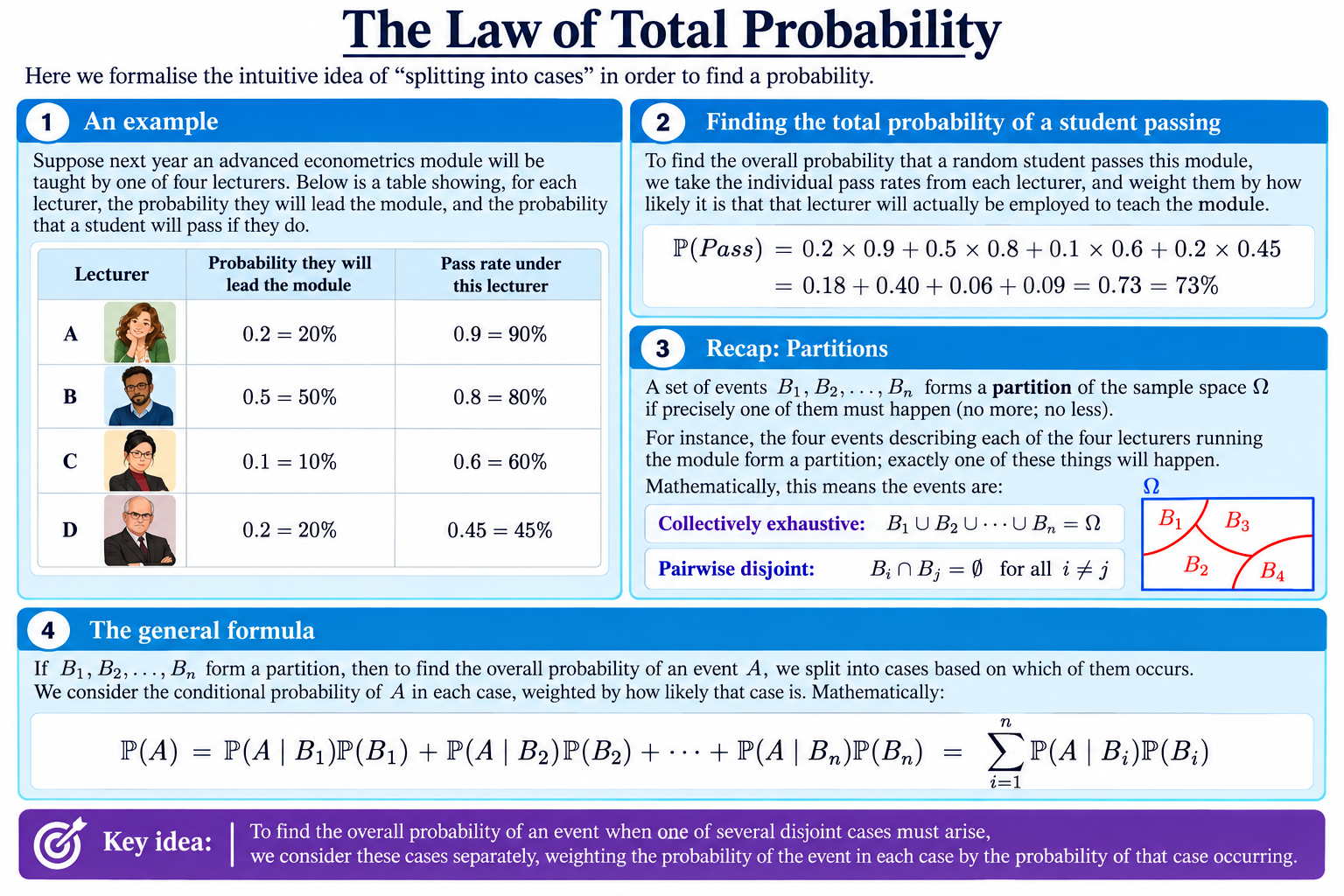
The Law of Total Probability
The law of total probability allows us to find an overall probability by splitting the problem into several possible cases. We find the probability within each case, weight it by the probability of that case occurring, and then add the results.
For example, suppose a pizza restaurant cooks $70$% of its pizzas in a wood-fired oven and the remaining $30$% in an electric oven. A pizza becomes burnt $3$% of the time in the wood-fired oven, but $10$% of the time in the electric oven.
The overall probability of receiving a burnt pizza is:
$$\mathbb{P}(\text{over-charred}) = 0.03(0.7) + 0.10(0.3) = 0.051$$
That is, $5.1$%.
For the law of total probability to apply, the cases in question must form a partition: exactly one of them must occur. In other words, the cases cannot overlap, and together they must cover all possibilities.
More generally, if $B_1,B_2,\ldots,B_n$ form a partition, then:
$$\mathbb{P}(A) = \sum_{i=1}^{n}\mathbb{P}(A \cap B_i) = \sum_{i=1}^{n}\mathbb{P}(A \mid B_i)\mathbb{P}(B_i)$$
The formula simply formalises the idea of splitting a probability calculation into cases.
Understanding Econometrics is completely free to use, and always will be.
If you found the site useful and would like to help me keep adding new material, please consider buying me a coffee! Buy me a coffee ☕