How Do We Find the Convolution of Two Sequences?
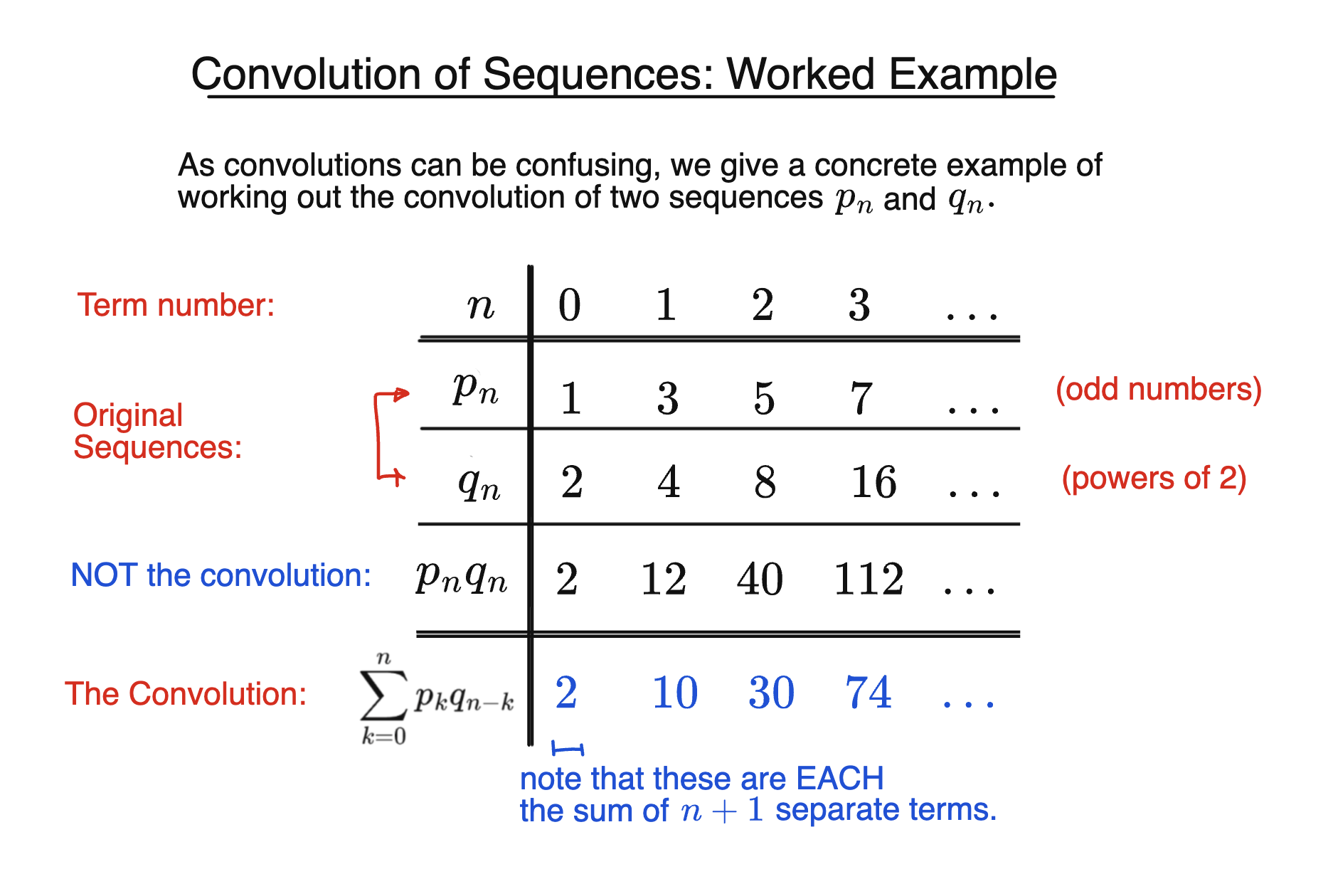
Convolutions can be a little confusing at first, so let’s work through a concrete example.
Consider the two sequences
$$p_0=1,\quad p_1=3,\quad p_2=5,\quad p_3=7,\dots$$
and
$$q_0=2,\quad q_1=4,\quad q_2=8,\quad q_3=16,\dots$$
The first contains the odd numbers, while the second contains powers of $2$.
More generally,
$$p_n=2n+1$$
and
$$q_n=2^{n+1}.$$
First: What the Convolution is NOT
It is tempting to multiply matching terms:
$$p_0q_0=2,\quad p_1q_1=12,\quad p_2q_2=40,\quad p_3q_3=112.$$
But this is not the convolution!
It is just the term-by-term, or pointwise, product of the two sequences.
The Convolution
Let the convolution have terms
$$r_0,\quad r_1,\quad r_2,\quad r_3,\dots$$
The general rule is
$$r_n=p_0q_n+p_1q_{n-1}+p_2q_{n-2}+\dots+p_nq_0.$$
So $r_n$ contains all products whose indices add up to $n$.
For example, let’s find $r_2$. The pairs of indices which add up to $2$ are
$$0+2,\quad 1+1,\quad 2+0.$$
So,
$$r_2=p_0q_2+p_1q_1+p_2q_0$$
and hence
$$r_2=1\times8+3\times4+5\times2=30.$$
The first few terms are:
| $n$ | $p_n$ | $q_n$ | $r_n$ |
|---|---|---|---|
| $0$ | $1$ | $2$ | $1 \times 2 = 2$ |
| $1$ | $3$ | $4$ | $1 \times 4 + 3 \times 2 = 10$ |
| $2$ | $5$ | $8$ | $1 \times 8 + 3 \times 4 + 5 \times 2 = 30$ |
| $3$ | $7$ | $16$ | $1 \times 16 + 3 \times 8 + 5 \times 4 + 7 \times 2 = 74$ |
Notice that, to find $r_n$, we need to use all the terms up to index $n$, but no later ones.
We can write the same rule more compactly as
$$r_n=\sum_{k=0}^n p_kq_{n-k}.$$
The important thing to remember is that we do not simply multiply terms with the same index (though these may be involved).
Rather, to find $r_n$, we multiply terms whose indices add up to $n$, then add all those products together.
Background:
Understanding Econometrics is completely free to use, and always will be.
If you found the site useful and would like to help me keep adding new material, please consider buying me a coffee! Buy me a coffee ☕