What is the Variance of a Vector?
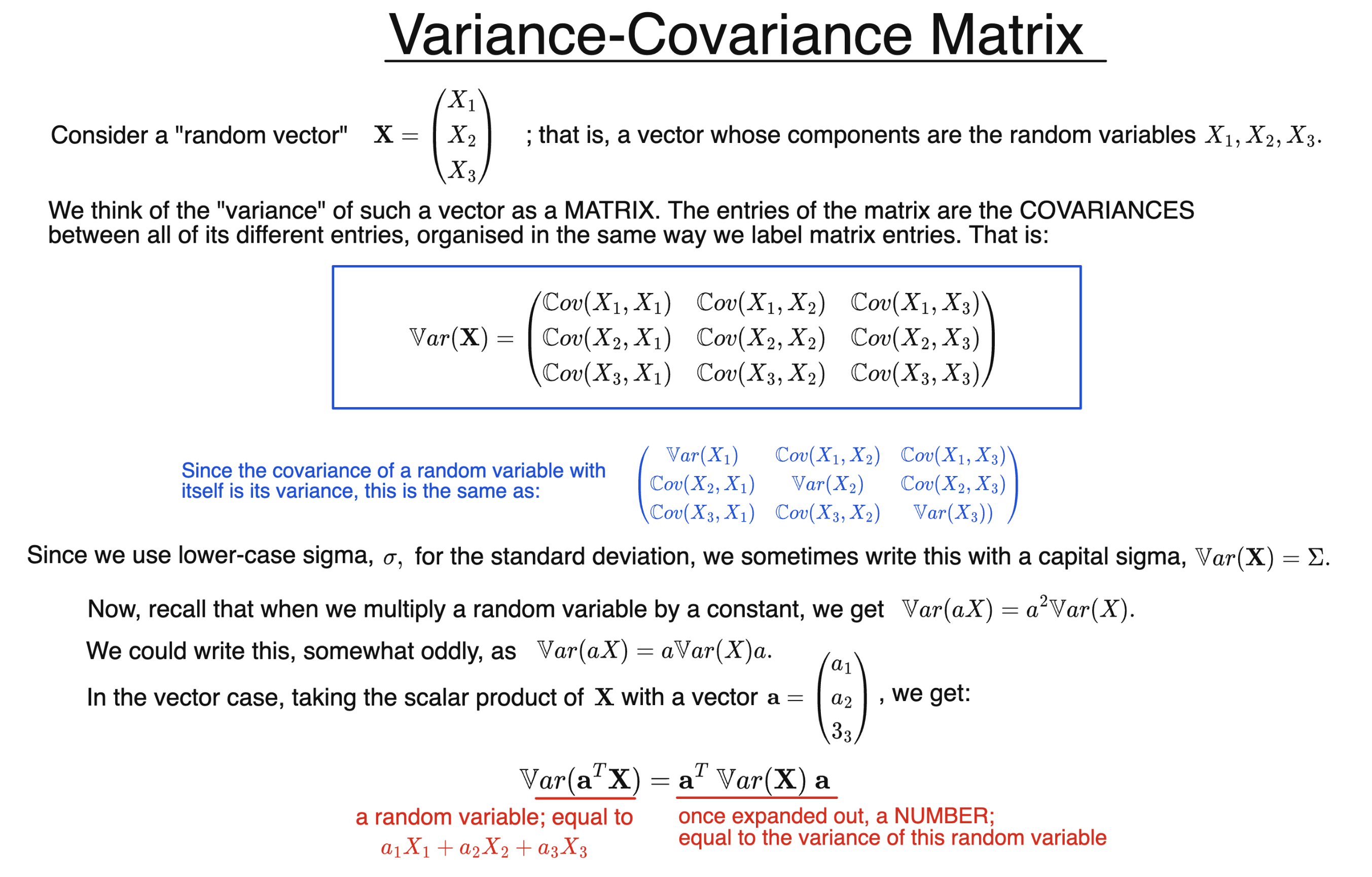
Suppose we collect several random variables into a random vector:
$$\mathbf{X}=\left(\begin{array}{c}X_1 \cr X_2 \cr \vdots \cr X_n\end{array}\right).$$
This gives us a “random vector”, which is simply a vector whose entries are random variables.
For a single random variable, the variance is one number. But for a random vector, its “variance” is instead a whole matrix! That is, the variance-covariance matrix, which contains the variances of each component and the covariances of each pair.
This matrix is formed as follows:
$$\operatorname{Var}(\mathbf{X})=\left(\begin{array}{cccc}\operatorname{Var}(X_1) & \operatorname{Cov}(X_1,X_2) & \cdots & \operatorname{Cov}(X_1,X_n) \cr \operatorname{Cov}(X_2,X_1) & \operatorname{Var}(X_2) & \cdots & \operatorname{Cov}(X_2,X_n) \cr \vdots & \vdots & \ddots & \vdots \cr \operatorname{Cov}(X_n,X_1) & \operatorname{Cov}(X_n,X_2) & \cdots & \operatorname{Var}(X_n)\end{array}\right).$$
The entries on the diagonal are variances, since
$$\operatorname{Cov}(X_i,X_i)=\operatorname{Var}(X_i).$$
The other entries are covariances between different components.
Since
$$\operatorname{Cov}(X_i,X_j)=\operatorname{Cov}(X_j,X_i),$$
the matrix is symmetric.
It is also common to write the variance-covariance matrix using a capital Greek letter sigma:
$$\operatorname{Var}(\mathbf{X})=\Sigma.$$
The Variance of a Linear Combination of Components
Recall that for an ordinary random variable,
$$\operatorname{Var}(aX)=a^2\operatorname{Var}(X).$$
Now let
$$\mathbf{a}=\left(\begin{array}{c}a_1 \cr a_2 \cr \vdots \cr a_n\end{array}\right)$$
be a vector of constants.
Then
$$\mathbf{a}^T\mathbf{X}=a_1X_1+a_2X_2+\dots+a_nX_n.$$
This is now a single random variable: a linear combination of the components of $\mathbf{X}$.
Its variance is
$$\operatorname{Var}(\mathbf{a}^T\mathbf{X})=\mathbf{a}^T\operatorname{Var}(\mathbf{X})\mathbf{a}.$$
If we write $\operatorname{Var}(\mathbf{X})=\Sigma$, this becomes
$$\operatorname{Var}(\mathbf{a}^T\mathbf{X})=\mathbf{a}^T\Sigma\mathbf{a}.$$
Although the expression on the right contains vectors and a matrix, once expanded out the result is just one number: the variance of the random variable $\mathbf{a}^T\mathbf{X}$.
The Variance of a Transformed Random Vector
We can also transform the whole random vector $X$ into another vector, using a matrix.
If $A$ is a constant matrix with $n$ columns, then
$$A\mathbf{X}$$
is another random vector.
Its variance-covariance matrix is
$$\operatorname{Var}(A\mathbf{X})=A\operatorname{Var}(\mathbf{X})A^T.$$
Using $\Sigma$ for the variance-covariance matrix of $\mathbf{X}$,
$$\operatorname{Var}(A\mathbf{X})=A\Sigma A^T.$$
So, this is different from the last case:
-
$\mathbf{a}^T\mathbf{X}$ is a single random variable, so its variance is one number.
-
$A\mathbf{X}$ is a random vector, so its variance is another variance-covariance matrix.
Notice also that in the second case the transpose “$T$” goes right at the end in the formula.
Background:
Understanding Econometrics is completely free to use, and always will be.
If you found the site useful and would like to help me keep adding new material, please consider buying me a coffee! Buy me a coffee ☕