What Is the F-Distribution?
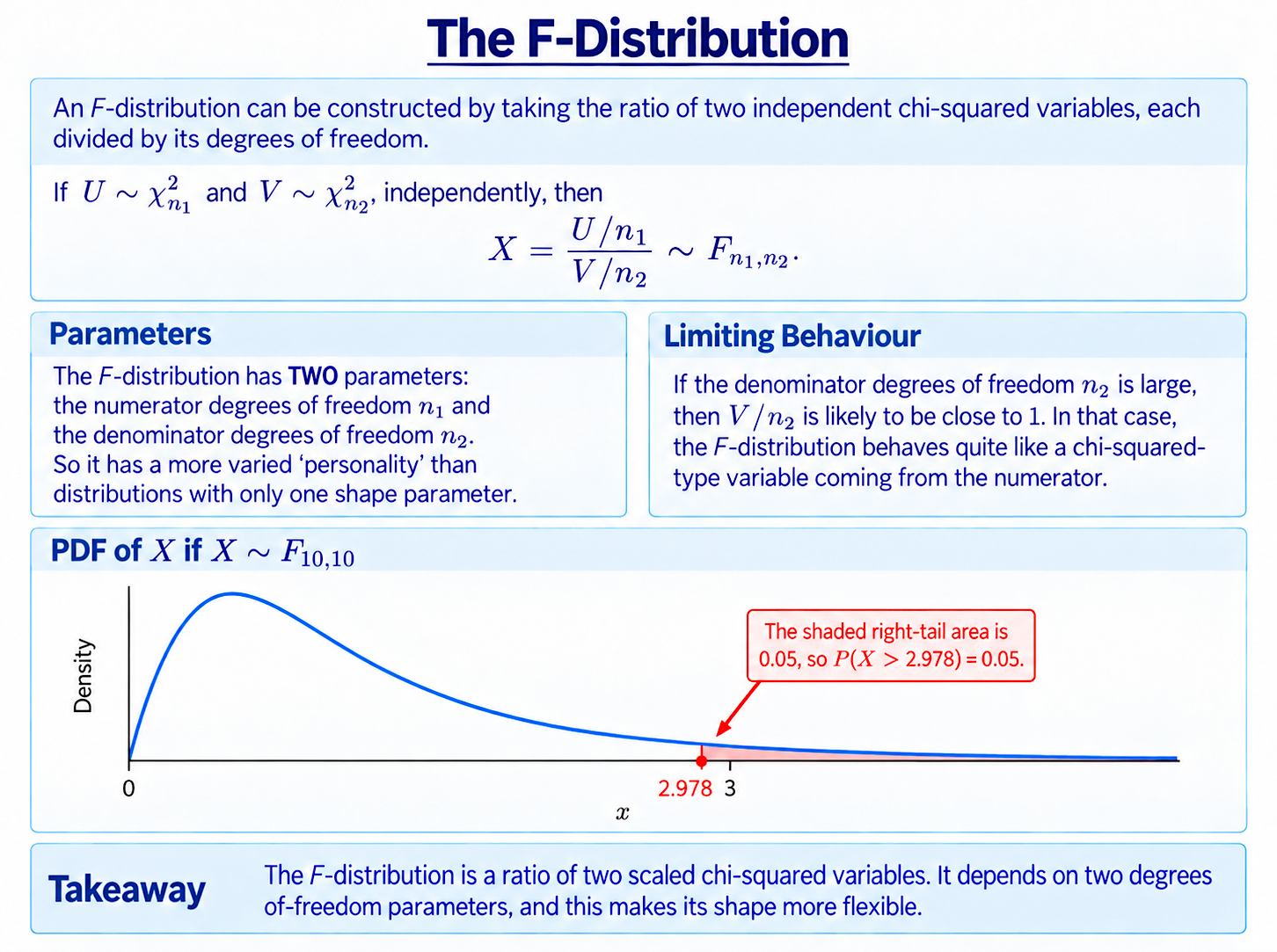
The F-distribution can be constructed by taking the ratio of two independent chi-squared random variables, after dividing each by its degrees of freedom.
Suppose
$$U\sim\chi_{n_1}^2$$
and
$$V\sim\chi_{n_2}^2,$$
where $U$ and $V$ are independent.
Then define
$$F=\frac{U/n_1}{V/n_2}.$$
The resulting random variable has an F-distribution:
$$F\sim F_{n_1,n_2}.$$
So the F-distribution is built entirely from the chi-squared distributions introduced earlier.
Two Degrees of Freedom
Unlike the chi-squared and t-distributions, the F-distribution has two degrees-of-freedom parameters.
In
$$F\sim F_{n_1,n_2},$$
$n_1$ is called the numerator degrees of freedom, while $n_2$ is called the denominator degrees of freedom.
They correspond directly to the two chi-squared random variables used in the construction:
$$F=\frac{U/n_1}{V/n_2}.$$
Changing either parameter changes the shape of the distribution, so the F-family has rather more variety than other distributions met earlier.
Why Is the F-Distribution Always Positive?
Both $U$ and $V$ are chi-squared random variables, so they can only take non-negative values.
The F-distribution therefore only has support on positive values:
$$F>0.$$
This also explains why its pdf is asymmetric rather than bell-shaped. For many choices of $n_1$ and $n_2$, the distribution is positively skewed, with a long right tail.
What Happens When the Denominator Degrees of Freedom Is Large?
The construction gives us a useful way to understand what happens when $n_2$ becomes large.
Since
$$V\sim\chi_{n_2}^2,$$
we know that
$$\mathbb{E}\left(\frac{V}{n_2}\right)=1$$
and
$$\operatorname{Var}\left(\frac{V}{n_2}\right)=\frac{2}{n_2}.$$
As $n_2$ increases, $V/n_2$ therefore becomes increasingly concentrated around $1$.
Looking again at
$$F=\frac{U/n_1}{V/n_2},$$
the denominator then has less and less effect. For large $n_2$, the F-distribution behaves increasingly like the scaled chi-squared random variable
$$\frac{U}{n_1}.$$
If both $n_1$ and $n_2$ are large, both parts of the ratio are concentrated around $1$, so the F-distribution itself becomes increasingly concentrated around $1$.
Interactive F-Distribution
The graph below lets you explore how the F-distribution changes with its two degrees-of-freedom parameters.
Use $n_1$ to change the numerator degrees of freedom and $n_2$ to change the denominator degrees of freedom.
You can also choose values $c$ and $d$. The shaded region shows
$$\mathbb{P}(c\leq F\leq d).$$
Try changing $n_1$ and $n_2$ separately and notice how each affects the shape of the pdf.
Why Is the F-Distribution Important?
The F-distribution appears naturally whenever we compare two independent quantities with chi-squared-type behaviour.
This makes it particularly important in statistics and econometrics, where many measures of variation are constructed from sums of squared quantities.
Later, the F-distribution will play an important role in hypothesis testing, especially in regression models where we want to test several restrictions together.
For now, the main idea to remember is its construction:
$$F=\frac{U/n_1}{V/n_2}.$$
An F-distributed random variable is the ratio of two independent scaled chi-squared random variables.
Background:
Understanding Econometrics is completely free to use, and always will be.
If you found the site useful and would like to help me keep adding new material, please consider buying me a coffee! Buy me a coffee ☕