What Is a Moment?
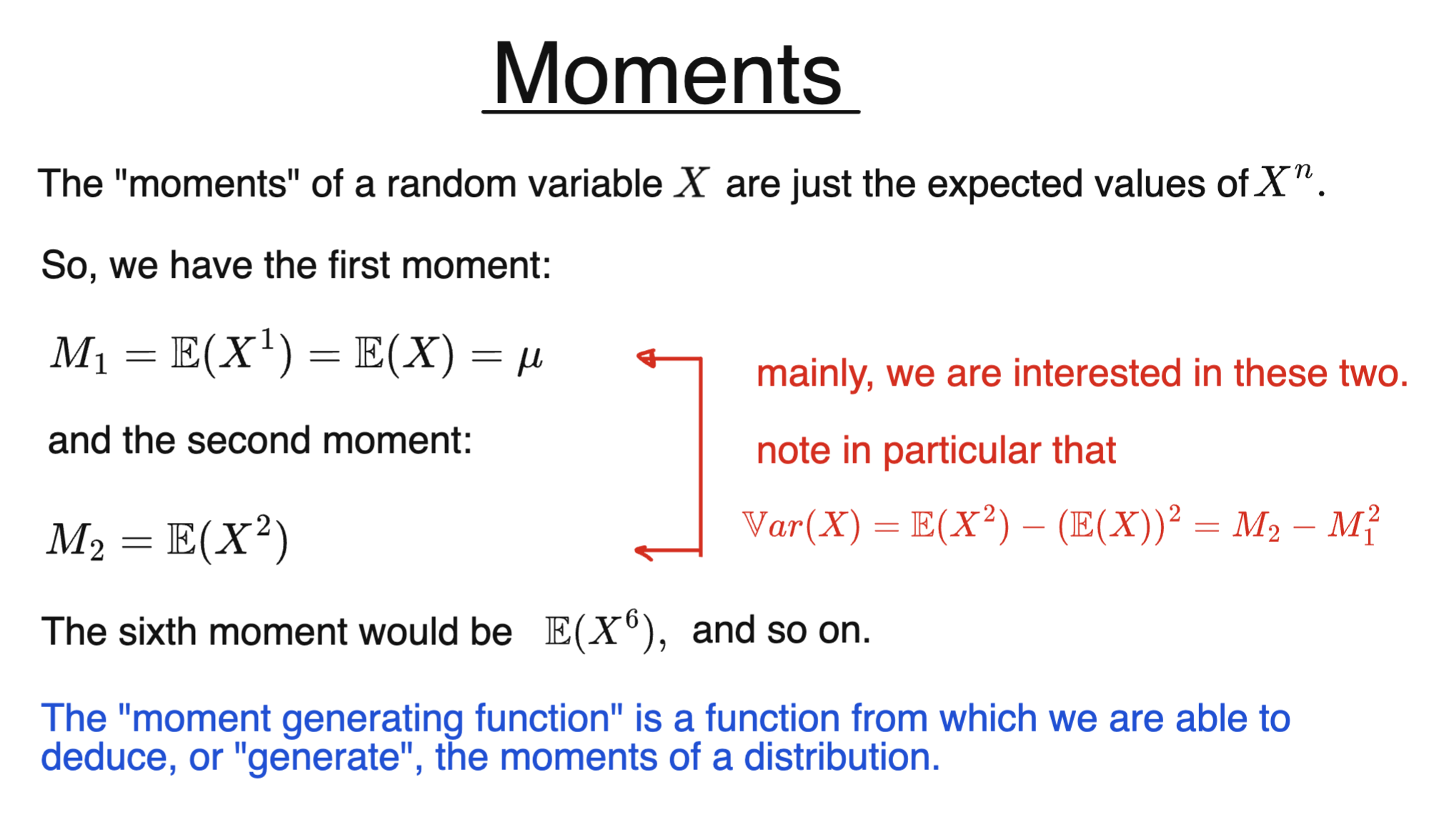
For a random variable $X$, its moments are simply the expected values of its powers:
$$\mathbb{E}(X^n).$$
We can write the $n$th moment as
$$M_n=\mathbb{E}(X^n).$$
Notice that $M_n$ is just a number. It is not itself a random variable or a function.
The First and Second Moments
The first moment is
$$M_1=\mathbb{E}(X).$$
This is simply the mean of $X$, which we often write as $\mu$:
$$M_1=\mathbb{E}(X)=\mu.$$
The second moment is
$$M_2=\mathbb{E}(X^2).$$
The first two moments are especially important because together they give us the variance:
$$\operatorname{Var}(X)=\mathbb{E}(X^2)-(\mathbb{E}(X))^2=M_2-M_1^2.$$
In probability, statistics, and econometrics, these are the moments we will use most often.
Higher Moments
We can continue in exactly the same way.
The third moment is
$$M_3=\mathbb{E}(X^3),$$
the fourth moment is
$$M_4=\mathbb{E}(X^4),$$
and, for example, the sixth moment is
$$M_6=\mathbb{E}(X^6).$$
Higher moments can also tell us more about the shape of a distribution. In particular, versions of the third and fourth moments that are centred around the mean and suitably scaled are used to measure skewness and kurtosis. Roughly speaking, skewness describes the asymmetry of a distribution, while kurtosis is related to how much probability weight lies in the tails.
As well as finding the expected values directly, another way to find moments is by using a “moment generating function”. This is covered on the next page.
Background:
Extensions:
Understanding Econometrics is completely free to use, and always will be.
If you found the site useful and would like to help me keep adding new material, please consider buying me a coffee! Buy me a coffee ☕