The Experiment
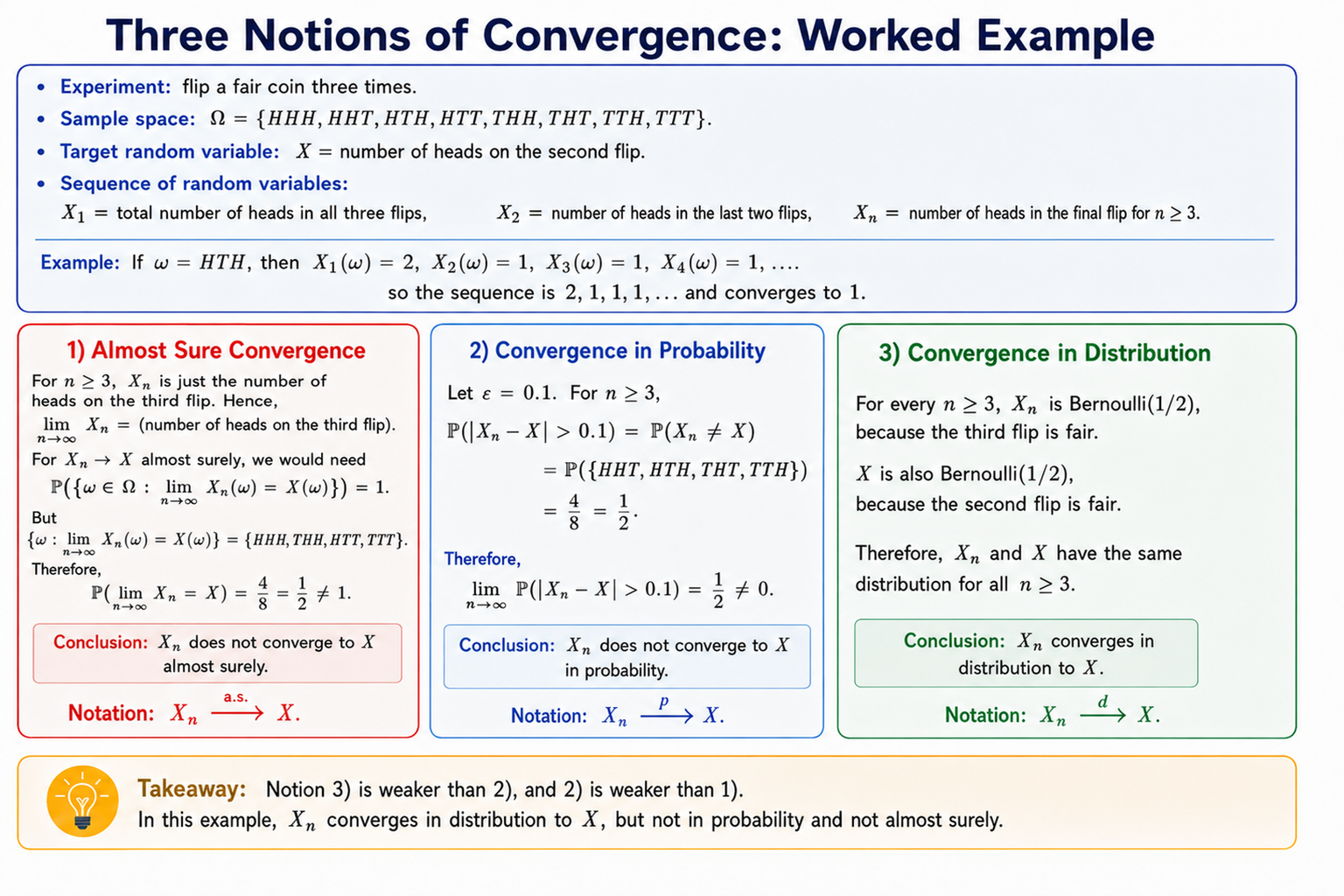
We now use a single example to compare our three notions of convergence, and see how they can give different answers about whether a sequence of random variables converges.
Suppose we flip a fair coin three times, so that our sample space is:
$$\Omega=\{HHH,HHT,HTH,HTT,THH,THT,TTH,TTT\}.$$
Our target random variable $X$ records the number of heads on the second flip.
Now define a sequence of random variables:
-
$X_1$ records the total number of heads in all three flips.
-
$X_2$ records the number of heads in the final two flips.
-
For every $n\geq3$, $X_n$ records the number of heads on the third flip.
For example, if
$$\omega=HTH,$$
then
$$X_1(\omega)=2,\qquad X_2(\omega)=1,\qquad X_3(\omega)=X_4(\omega)=\dots=1.$$
So the realised sequence is
$$2,1,1,1,\dots$$
which converges to $1$.
However, our target $X$ looks at the second flip. So, since $\omega=HTH$, the second flip is tails, and we have:
$$X(\omega)=0.$$
Thus, for this particular outcome,
$$\lim_{n\to\infty}X_n(\omega)=1\neq0=X(\omega).$$
That is, for $\omega=HTH$, our sequence of numbers converges — but not to the target!
We now ask whether the sequence of random variables $X_n$ converges to our target $X$ according to each of our three notions of convergence.
Does $X_n$ Converge to $X$ Almost Surely?
For every $n\geq3$, $X_n$ records whether the third flip is heads, while $X$ records whether the second flip is heads.
Therefore, the condition
$$\lim_{n\to\infty}X_n(\omega)=X(\omega)$$
will hold precisely when the second and third flips are the same.
This happens for the outcomes
$$\{HHH,THH,HTT,TTT\}.$$
Hence
$$\mathbb{P}(\{\omega\in\Omega:\lim_{n\to\infty}X_n(\omega)=X(\omega)\})=\frac{4}{8}=\frac{1}{2}.$$
Almost sure convergence would require this probability to equal $1$.
Therefore, $X_n$ does not converge almost surely to $X$.
Does $X_n$ Converge to $X$ in Probability?
Take
$$\varepsilon=0.1.$$
Since both $X_n$ and $X$ are either $0$ or $1$, the condition
$$|X_n-X|>0.1$$
holds exactly when they are different: $X_n\neq X$.
For every $n\geq3$, this happens precisely when the second and third flips differ, which has probability
$$\mathbb{P}(|X_n-X|>0.1)=\frac{4}{8}=\frac{1}{2}.$$
So
$$\lim_{n\to\infty}\mathbb{P}(|X_n-X|>0.1)=\frac{1}{2}.$$
Convergence in probability would require this limit to be $0$. Therefore, $X_n$ does not converge in probability to $X$.
Does $X_n$ Converge to $X$ in Distribution?
Here we get a different answer.
For every $n\geq3$, $X_n$ records whether the third flip is heads. Since the coin is fair,
$$X_n\sim\operatorname{Bernoulli}\left(\frac{1}{2}\right).$$
Our target $X$ records whether the second flip is heads, so likewise
$$X\sim\operatorname{Bernoulli}\left(\frac{1}{2}\right).$$
Thus $X_n$ and $X$ have exactly the same distribution for every $n\geq3$.
Therefore,
$$X_n\overset{d}{\longrightarrow}X.$$
What Does This Show?
In this example, $X_n$ converges in distribution to $X$, but not in probability and not almost surely.
So, we have a concrete example showing that the implications in
$$\text{Almost Sure Convergence}\Rightarrow\text{Convergence in Probability}\Rightarrow\text{Convergence in Distribution}$$
cannot, in general, be reversed.
Background:
Understanding Econometrics is completely free to use, and always will be.
If you found the site useful and would like to help me keep adding new material, please consider buying me a coffee! Buy me a coffee ☕